
There were four new cases involving the right to protest and freedom of expression in July 2025, one of which was a Section 112 case, one related to Public Assembly Act, one related to Emergency Decree and a case related to the use of explosive devices during the 2021 assembly.
Regarding the Section 112 cases, verdicts have been delivered in six cases, all of which convicted the defendants and sentenced them to unsuspended jail terms. All of them have been granted bail pending trial in either the Appeals Court or the Supreme Court. A ruling has also been made in an assembly-related case concerning the Emergency Decree in which the defendants received suspended sentences. Accordingly, there were no new political prisoners last month.
At least five cases have been prosecuted last month, three of which concerned Section 112:one about an insult to the Constitutional Court and another one related to the assemblies by Thalu Gaz. All of them will proceed to trial.
In addition, last month saw the case of ‘Fah’ Suthinee, a defendant in Section 112 case who had applied for permission to travel abroad to further her study after being awarded the Erasmus scholarships. The case was dismissed by the Court.
Meanwhile, the House of Representatives was deliberating bills to grant amnesty and eventually voted down the two amnesty bills proposed by the Move Forward Party (former name) and by the public, respectively, while approving in principle the three other bills which failed to address all issues and periods when major conflicts arose. Such amnesty which discriminates and fails to address the impact of Section 112 cases and other pertinent cases will never lead to resolving conflicts. Rather, it will simply drive a wedge and exacerbate the long-standing problems.
.
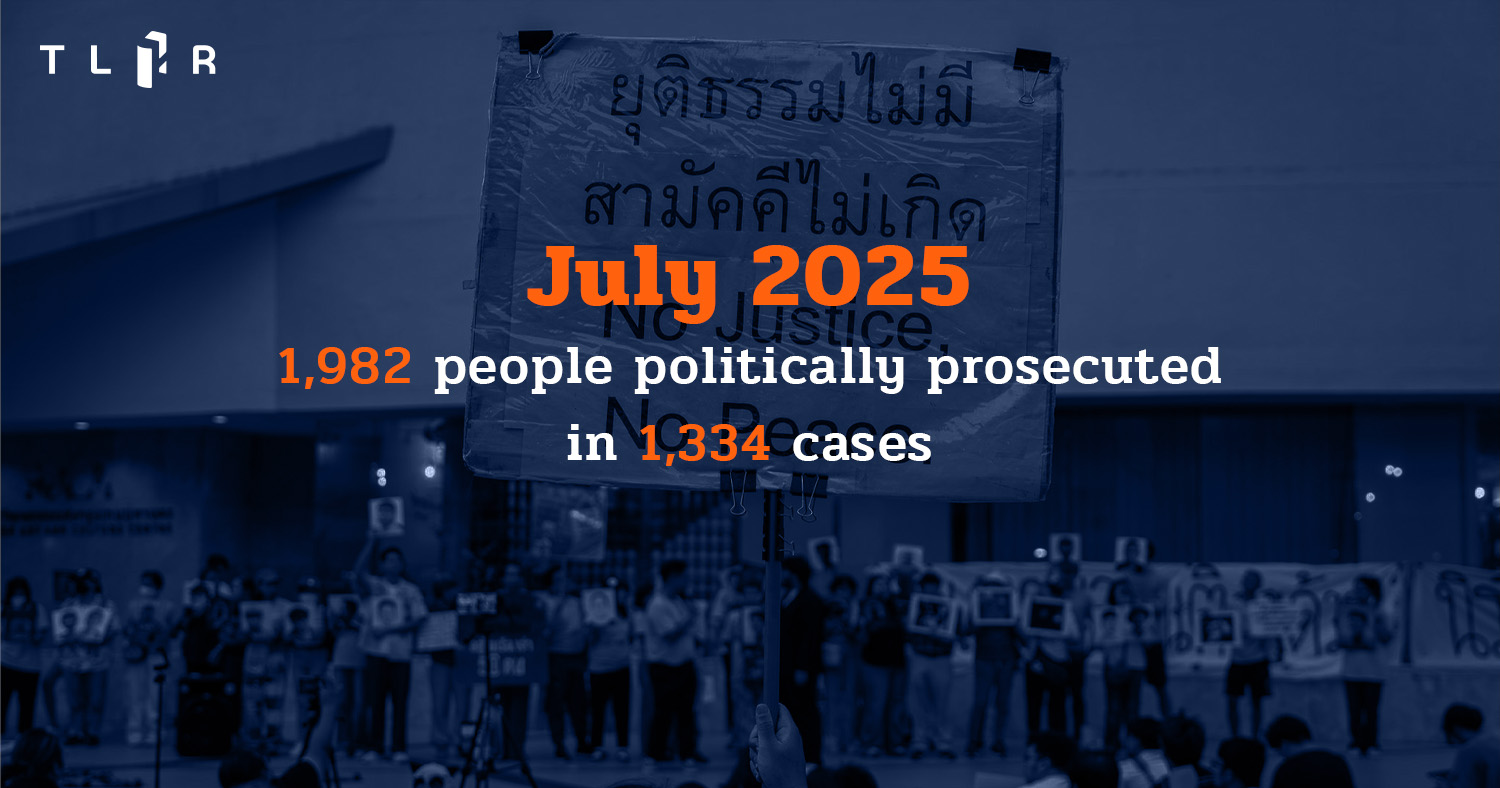
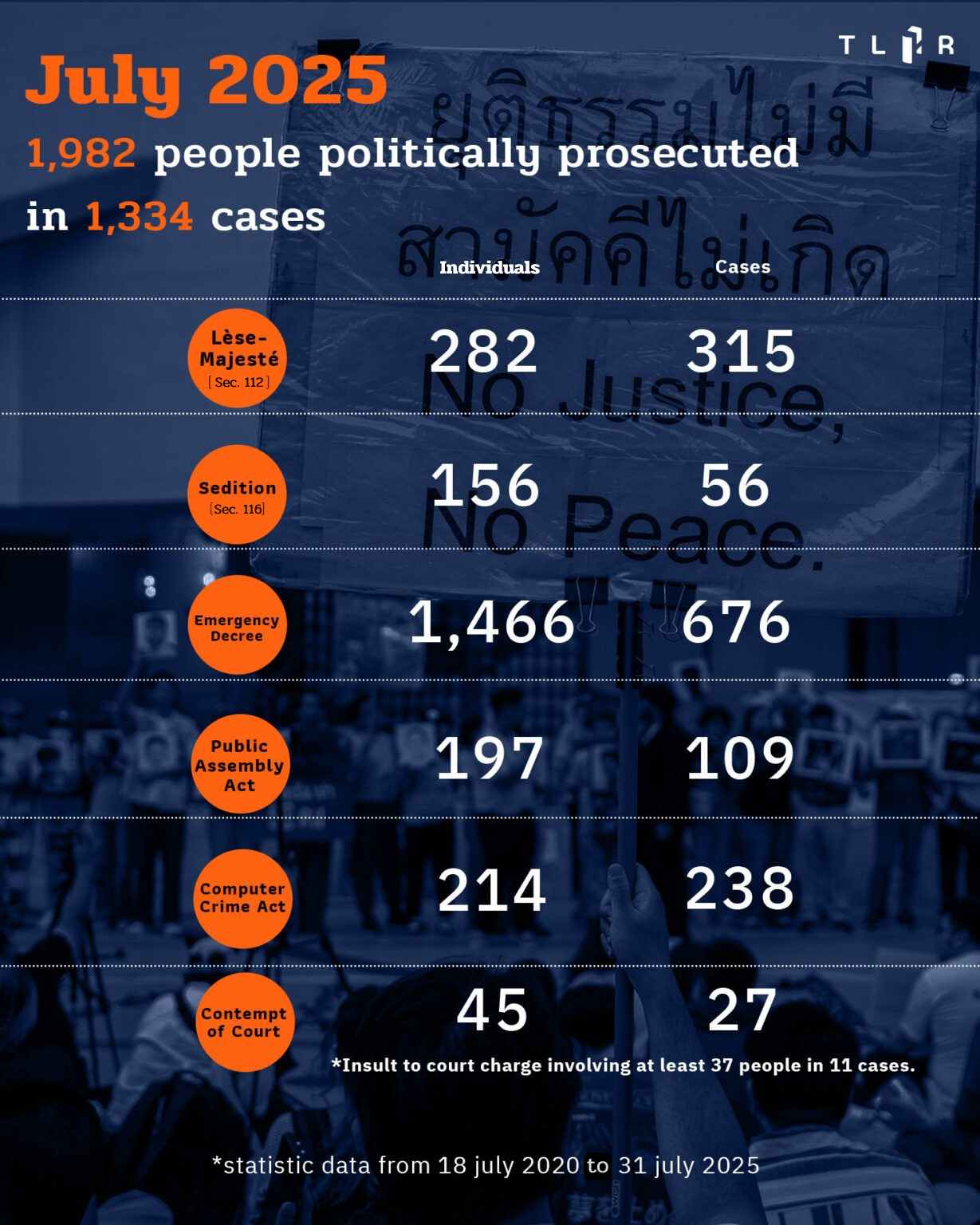
According to documentation from Thai Lawyers for Human Rights, since the “Free Youth” assembly on 18 July 2020 until 31 July 2025, at least 1,982 individuals have been charged for participating in public assemblies or expressing their political opinions in 1,334 cases. Compared with June 2025, there have been three new cases.
Altogether, there have been at least 4,058 legal actions against individuals; some of them are charged for multiple offences.
Prosecution statistics in key offences;
1. Section 112 (lèse-majesté) of the Criminal Code, at least 282 individuals in 315 cases (Of this, at least 168 cases have stemmed from reports to the police made by members of the public.)
2. Section 116 (sedition) of the Criminal Code, at least 156 individuals in 56 cases
3. Violation of the Emergency Decree, at least 1,466 individuals in 676 cases
4. Violation of the Public Assembly Act, at least 197 individuals in 109 cases
5. Violation of the Computer Crimes Act, at least 214 individuals in 238 cases
6. Contempt of court, at least 45 individuals in 27 cases, and insult of the court, at least 37 individuals in 11 cases
Of 1,334 cases, 730 cases have reached their final verdicts (although some cases remain outstanding, since certain defendants decided to appeal the verdicts, while others have not).
.
.
Prosecution trend in July 2025 and key events:
Charged for violating Public Assembly Act following protest against Min Aung Hlaing; reindictments on case concerning ##Mob16AugToToppleTyrants assembly– defendants again required to wear EM
Last month, four more cases arose including one Section 112 case, one Public Assembly Act, one Emergency Decree case and one case related to explosive material from the assemblies in 2021.
The Public Assembly Act case stemmed from the assembly held at the Myanmar Embassy to protest Senior General Min Aung Hlaing, leader of the Myanmar coup while participating in BIMSTEC meeting in Thailand on 5 April 2025. The accused, an activist, was charged and fined by the inquiry officer of the Yannawa Police Station for “holding a public assembly without notifying the concerned authorities at least 24 hours prior” according to the Public Assembly Act.
As for the other Emergency Decree case, it stemmed from the #Mob16AugToToppleTyrants assembly at the Victory Monument on 16 August 2021, involving Songphon “Yajai” Sonthirak, Nawapol Tonngam, and Pimchanok Jirathaiyanon, who have now been reindicted. In the earlier proceedings, one of the defendants, Jessadaphon, pleaded guilty, and the Court temporarily disposed of the case. Now, the accused have been re-indicted and are required to wear Electronic Monitoring (EM) devices while on bail, as was the case during their previous indictment.
As to the Section 112 case, TLHR shared new findings regarding Niyom Nopparat (Kay Red Shirt) who has reportedly been charged since November 2024 in the case filed with the Technology Crime Suppression Division by Songchai Nianhom, following his sharing of Somsak Jeamteerasakul’s Facebook post.
Eventually, in the case related to explosive material during the assemblies in 2021, three members of the public have been accused of throwing Ping Pong bombs at the crowd control police in front of Sam Yan Mitra Town during the #Mob16Jan21 assembly, and TLHR just discovered and added the information last month.
In another matter, related to explosive materials during the 2021 assemblies, three members of the public have been accused of throwing ping-pong bombs at crowd control police in front of Sam Yan Mitr Town during the #Mob16Jan21 assembly. TLHR discovered and added this information only last month.
.
All six Section 112 cases resulted in convictions with unsuspended sentences; however, bail was granted in each case, meaning no additional individuals were incarcerated last month.
Throughout July 2025, verdicts were issued in at least six Section 112 cases, including one by the Supreme Court, two by the Court of Appeal, and three by the Trial Court. One case was dismissed under Section 112 but resulted in a conviction under Section 116. In all cases that led to convictions, the sentences were imposed without suspension; however, the defendants were granted bail while their cases proceed in higher courts.
In cases where the defendants pleaded not guilty—including that of “Bang-earn,” a 26-year-old freelance artist from Khon Kaen accused of posting a photo of himself pointing his feet at a portrait of His Majesty the King on 29 July 2023—the Criminal Court ruled that, because the photo was posted on the King’s birthday, it demonstrated the accused’s intent to insult His Majesty. The Court further held that his action provoked public anger and deepened social divisions. He was therefore sentenced to three years’ imprisonment without suspension, though he was granted bail pending appeal.
In the case against Wanwalee “Tee” Thammasattaya, a 25-year-old political activist accused of delivering a speech at a public assembly at the King Taksin the Great Monument, Wong Wian Yai, on 6 December 2020, the Court of Appeal upheld the previous verdict. The Court ruled that Section 112 applies not only to the reigning monarch and found that the content of her speech was derogatory, thereby damaging the reputation of King Rama X. She was sentenced to two years and eight months’ imprisonment without suspension, though she was granted bail pending appeal.
In the case against Arnon Nampha and Parit Chiwarak, stemming from their speeches at the #Mob17Nov20 #IOrderThatYouStayUnderConstitution rally in front of Parliament on 17 November 2020, the Criminal Court acquitted Parit of charges under Section 112, ruling that his remarks referred to the National Assembly and were not defamatory toward the King.
As for Arnon, although his speech did not directly mention King Rama X by name, the Court found that his references to “phony acts” implied criticism of the King and Princess Sirivannavari. He was therefore found guilty under Section 112. Both Arnon and Parit were also found guilty under Section 116. In total, Parit was sentenced to four months’ imprisonment, while Arnon received two years and four months. Based on the cumulative sentences imposed by the Trial Courts to date, Arnon now faces a total prison term of 26 years, 37 months, and 20 days—equivalent to approximately 29 years and one month.
In the case against Wanwalee “Tee” Thammasattaya, along with Nueng and Nam (pseudonyms), for allegedly posting a photo of themselves holding placards during the #ByeByeDinosaur assembly in Bangkok on 21 November 2020, the Court of Appeal Region 5 overturned the previous verdict and found all three defendants guilty under Section 112. Each was sentenced to two years and eight months’ imprisonment without suspension, though they were granted bail pending appeal. Previously, the Chiang Mai Provincial Court had convicted only Wanwalee while acquitting the other two defendants.
In the two cases in which the defendants pleaded guilty, including that of a 30-year-old electrician known as “Laufeyson,” who allegedly commented on a post in the “Royalist Marketplace Facebook Group” in 2021, the Criminal Court initially sentenced him to three years’ imprisonment. Due to his guilty plea, the sentence was reduced to one year and six months without suspension, though he was granted bail pending appeal.
In the case against Ukrit “Kong” Santiprasitkul, a 26-year-old law student from Ramkhamhaeng University and a member of the Thaluram Group, who allegedly shared posts related to protests against King Rama X in 2020, the Supreme Court upheld the Court of Appeal Region 1’s verdict. He was sentenced to two years’ imprisonment without suspension, bringing the case to a final verdict after he had already been incarcerated for nearly one year and six months.
.
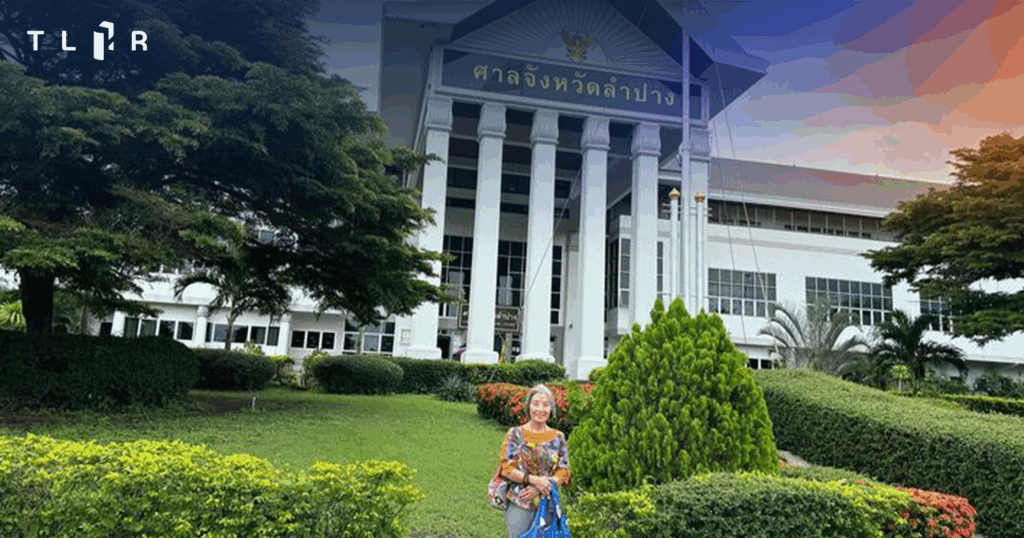
An appeal seeking compensation in the case concerning ‘Surachai Sae Dan’ was dismissed, as the Court found insufficient evidence to prove his death.
Last month, the Court of Appeal dismissed the case filed by Pranee Danwattanusorn, wife of Surachai Sae Dan. Previously, both the Subcommittee and the Committee to Determine Compensation for Aggrieved Parties in Criminal Cases had rejected her application for compensation under the Act on Compensation of Aggrieved Parties and the Accused in Criminal Cases, as it was determined that Surachai had been a victim of enforced disappearance since 2018.
The Court of Appeal ruled that there was no evidence to indicate that Surachai had died or suffered fatal mental or physical injuries, and therefore dismissed the case. As a result, any attempt to claim compensation in Surachai’s case under this law is effectively blocked.
.
.
There was also at least one verdict in another case related to public assemblies and political expression, involving three members of the public—Areefin So, Prasert Ratchaniyom, and Abdul Sattar Balo—who were accused of holding and participating in the “Car Mob Yala” on 1 August 2021. The Supreme Court upheld the Court of Appeal Region 9’s verdict, finding all three guilty of violating the Emergency Decree and sentencing them to two months’ imprisonment, though the sentences were suspended.
Regarding the situation of political prisoners in July, no new inmates were admitted, while one convict, Sathaphon, was released. Concerning bail applications, none of the remaining political prisoners were granted bail.
.
The Bangkok South Criminal Court has denied travel permission for ‘Fah’ Suthinee (last name withheld), a Section 112 defendant, to pursue postgraduate studies in children’s literature after being awarded an Erasmus scholarship.
Previously, the Court had allowed ‘Fah” Suthinee to post bail on the condition that she could not travel outside the Kingdom without prior approval. ‘Fah’ is accused of reading statements during an assembly in front of the German Embassy on 26 October 2020.
Last month, Suthinee filed a request with the Court seeking permission to travel abroad after receiving an Erasmus Mundus scholarship for her postgraduate studies in Children’s Literature, Media, and Cultural Entrepreneurship (CLMCE). She is scheduled to pursue the 24-month program from 15 September 2025 to 15 September 2027.
Despite emphasizing the significance of the Erasmus scholarship—highlighting that recipients must demonstrate outstanding academic performance and the potential to be high achievers, and that the program offers an opportunity to advance knowledge and engage with an international network of experts in children’s literature and media, with all expenses covered—the Bangkok South Criminal Court dismissed Suthinee’s request. It remains to be seen whether the Court will reconsider if she resubmits her application for permission to study abroad.
.
.
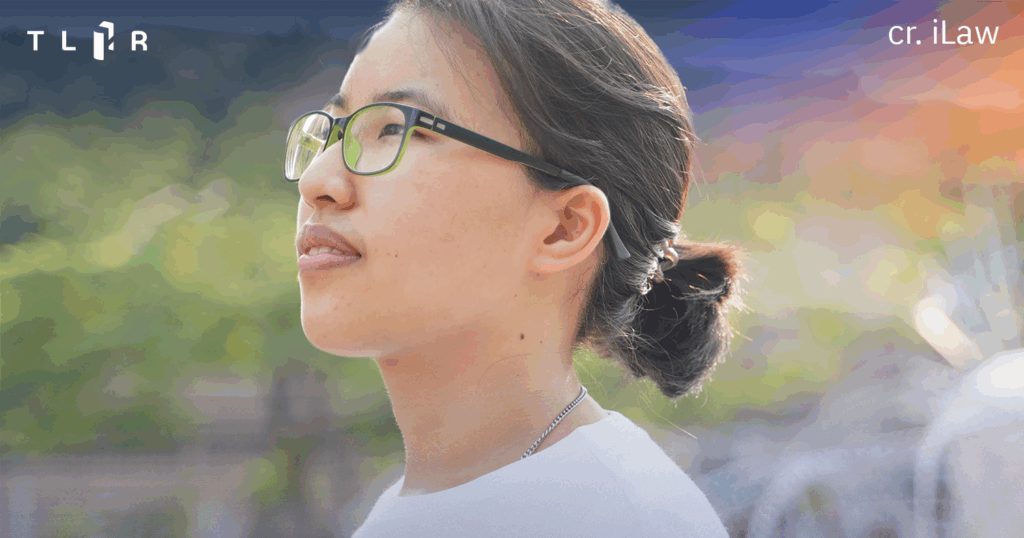
At least three prosecutions under Section 112 were filed last month, along with a separate prosecution in the ‘Rama Tulakan’ case, marking the first instance of charges for allegedly insulting the Constitutional Court.
At least five new prosecutions were filed in July 2025, including three under Section 112, one for contempt of court, and one related to the Thalu Gaz assembly. Regarding the Section 112 cases, one involved Nawat (Amp) Liangwattana, who was accused of speaking at the “Shining Light for Democracy” event at the Ratchaprasong intersection on 14 August 2023; this case was prosecuted in the Criminal Court.
The second case involves “Nat” Theerameth (last name withheld), a 21-year-old member of the public and a “special needs child” with an intellectual disability, who was alleged to have shared a TikTok clip showing himself crouching over a portrait of His Majesty the King on 12 February 2023. The case was reported to the police by the leader of the People’s Center for the Protection of Monarchy and later prosecuted in the Phatthalung Provincial Court. Nat has been granted bail.
In the case against Jutatip “Aua” Sirikhan, Passaravalee “Mind” Thanakitvibulphol, and Chanin “Ball” Wongsri, the three were accused of participating in an assembly in front of Parliament (#GoingToParliamentToToppleFeudalLord’sHenchmen) on 24 September 2020. They were indicted in the Criminal Court for violations of Section 112, Section 116, Section 215, the Emergency Decree, and the Communicable Disease Act. All three defendants have been granted bail.
Regarding the case related to the MobThalu Gaz assembly, also known as #Mob6Oct21, at the Samliam Din Daeng Intersection, Pipat and six others were accused of clashing with crowd control police, resulting in injury to one officer. They were indicted in the Criminal Court on four charges related to holding an illegal assembly and resisting or obstructing officials, excluding the “criminal association” charge that had previously been filed by the police.
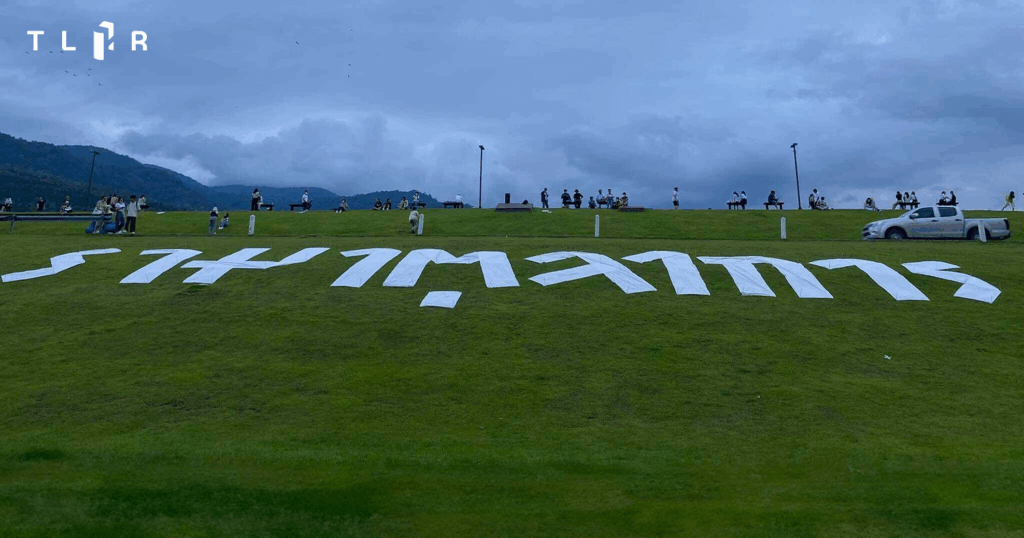
In addition, in the “Rama Tulakan” case, three activists from Chiang Mai were accused by the Office of the Constitutional Court of “being complicit in insulting the Court or its judges” following their activity expressing disagreement with the Constitutional Court’s ruling on General Prayut Chan-ocha’s eight-year tenure as Prime Minister. The activity took place at Ang Kaew, Chiang Mai University, on 30 September 2022.
.
.
Among cases involving allegations of insulting the Constitutional Court, this marks the first prosecution brought to court since the political assemblies led by the Free Youth in 2020. In two other similar cases, one against Parit Chiwarak was dropped after the public prosecutor issued a non-prosecution order, while another case involving six students and activists remains under police investigation.
TLHR submitted an opinion to the Criminal Court in response to the Court’s order prohibiting reporting on the trials of seven Section 112 cases, citing a breach of the principle of public trials.
On 1 July 2025, the Thai Lawyers for Human Rights (TLHR) filed a petition with the Chief Judge of the Criminal Court to submit its legal opinion regarding court proceedings. This action follows incidents beginning in late March 2025, when the Criminal Court began imposing gag orders, particularly in proceedings related to Section 112 cases and political matters of public interest. Under these orders, reporting on courtroom incidents to the public is prohibited without prior permission. To date, at least seven cases have been affected by this restriction.
TLHR’s letter emphasizes the right to a public trial, which forms part of the broader right to a fair trial. In all court proceedings, regardless of the alleged offense, families, relatives, friends, human rights organizations, media, and interested members of the public should be allowed to attend. Public trials serve as a key mechanism to ensure transparency in the exercise of judicial power and to guarantee that the accused are afforded the right to equality of arms.
The ‘People’s Amnesty’ Bill was voted down, while the amnesty bills that were passed failed to cover all offenses related to the conflicts.
Last month also saw a key development in the reading of five draft acts aimed at granting amnesty by the House of Representatives. Three of the drafts received approval, including those proposed by the United Thai Nation (UTN), the Khru Thai Party (former name), and the Bhumjaithai Party (BJT), while the two drafts proposed by the Move Forward Party (former name) and the Network for People’s Amnesty were voted down.
In 2024, at least 35,905 members of the public signed a petition proposing the “People’s Amnesty Bill” to address longstanding political conflicts in Thailand. This bill specifically included provisions for granting amnesty to offenders under Section 112.
Meanwhile, the Peaceful Society Enhancement Bill, which attracted the most attention and votes, does not grant amnesty for cases occurring from 2023 onward and excludes a range of offenses, including Section 112. As a result, several individuals convicted of political offenses will not benefit from the law.
TLHR affirms that should the House of Representatives genuinely want to address political conflicts, such amnesty laws should apply to all kinds of offences of affected parties without discrimination. Apart from alleviating conflicts, an amnesty to offences related to Section 112 also aligns with human rights standards of the international community.
In addition, while the amnesty laws are being deliberated, the government can instantly uphold the right to bail for all people incarcerated in politically motivated cases pending the trial. The authorities could also consult with the Office of the Attorney General to either refrain from prosecution or withdraw charges under Section 21 of the Public Prosecution Organ and Public Prosecutors Act 2010 for cases that may not serve the public interest—particularly those arising from political assemblies in 2020, which remain under investigation.
Selective amnesty that excludes Section 112 offenses and other politically sensitive cases will not resolve outstanding conflicts. On the contrary, it risks entrenching societal divisions, creating additional problems, and potentially triggering future violent eruptions.
.
ข่าวหรือบทความที่เกี่ยวข้อง

January 2015: Hearing schedule of five cases assisted by TLHR
Press Release January 2015: Hearing schedule of five cases assisted by TLHR During the latter half of January 2015, there are five cases handled by the Thai Lawyers for Human Rights (TLHR) to go on trial including; PDRC demonstration site bombing in Trat province (Black Case no. O1213/2557, Trat Provincial Court) Prosecution witness examination […]

Thai Lawyers for Human Rights
19/01/2558 Press Release A Wolf’s Bride verdict to be delivered at the Bangkok Criminal Court at 13.30 on 23 February
For immediate release on 20 February 2015 Press Release A Wolf’s Bride verdict to be delivered at the Bangkok Criminal Court at 13.30 on 23 February On Monday 23 February at 13.30, the Criminal Court is going to deliver a verdict on the Black Case no. 3528/2557 filed by the public prosecutor against Mr. Patiwat […]

admin
20/02/2558 Public Statement Condemning Bomb Attacks in Southern Thailand, Demanding Fair Trial Rights and Transparent Investigation
Public Statement Condemning Bomb Attacks in Southern Thailand, Demanding Fair Trial Rights and Transparent Investigation During 11-14 August 2016, 17 explosions took place in seven provinces in Southern Thailand causing a number of lives and damages. Since 13 August 2016, the Thai authorities have responded by invoking Section 44 of the Constitution of the […]

TLHR
15/08/2559
A roundup on 28 April: Eight alleged admins of Facebook pages raided and held in custody at the CSD, Criminal Court to deliver an order on the habeas corpus case at 10.00am on 29 April
There were two developments on 28 April 2016. First, relatives of the persons held in custody have gone to the Bangkok Criminal Court to file a complaint asking the Court to review the lawfulness of the detention and to have them released from custody. The Court will deliver the verdict on 29 April at 10.00am. […]