
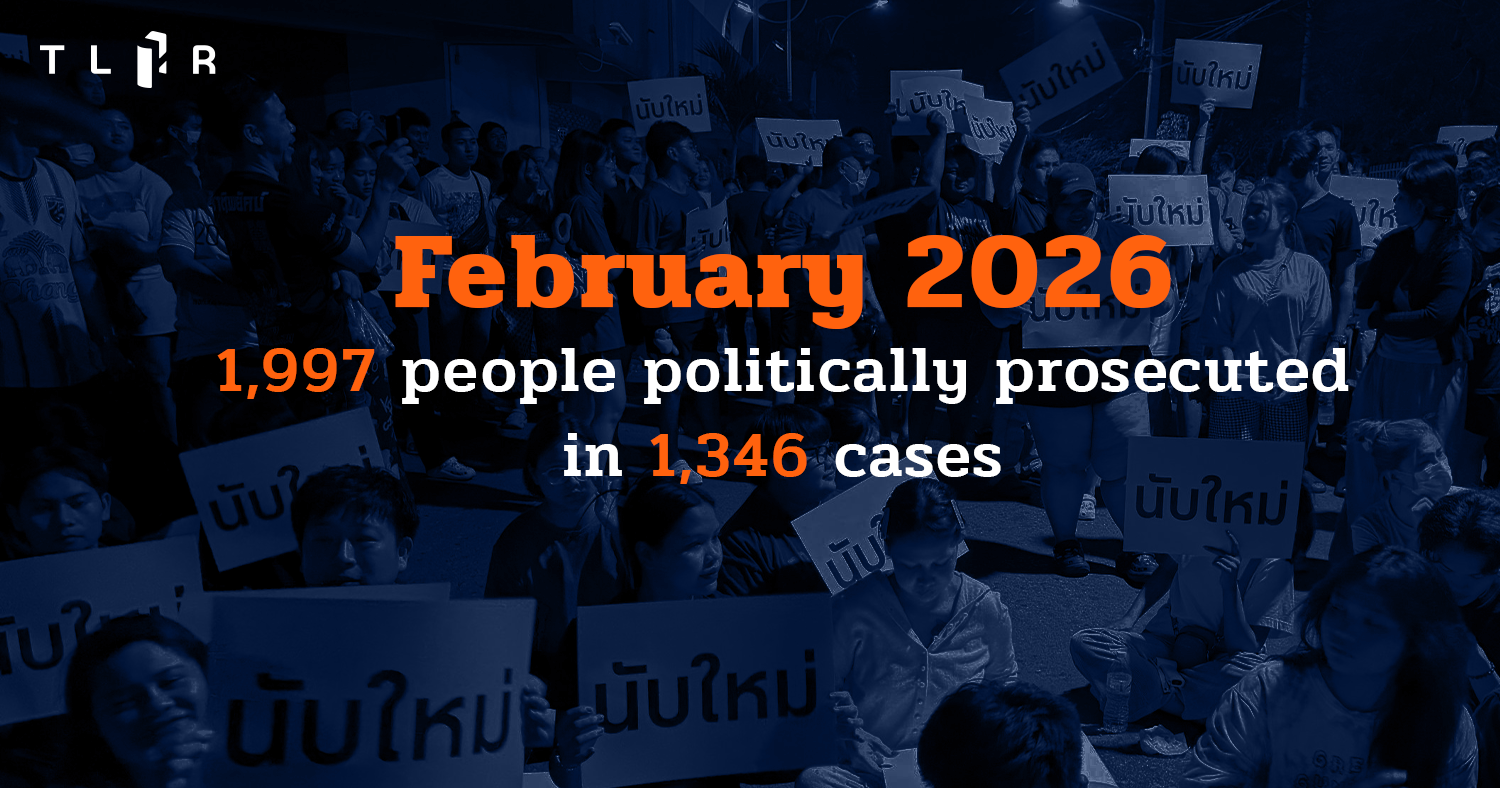
In February 2026, there were four additional political cases relating to freedom of expression. The first set of cases concerns cases related to the 2026 national election: Tewa Sritawan’s case, stemming from throwing a bag of fermented fish against the walls of the Election Commission; another case; and a case concerning a citizen charged for posting a message.
There were two additional cases counted under Section 112 statistics. The first case concerned protest leaders of United Front of Democracy Against Dictatorship, stemming from the situation following the crackdown on 2010 protests. It has been found that the Criminal Court has only recently delivered its judgment. The second case concerned two protest leaders of The People and Student Network for the Reform of Thailand under the Public Assembly Act.
.
During the past month, verdicts were delivered in at least six cases, including four cases under Section 112 and two other cases. All four cases under Section 112 resulted in a guilty verdict.
Concerning cases under Section 112, “Vuttipat” and ‘Singto” have been transported to imprisonment after the Court sentenced Vuttipat to 3 years and 4 months, while the Supreme Court rejected Singto’s bail application, following after the Appeals Court sentenced Singto to 1 year and 6 months in prison.
As for other cases, including the case against for Sirawich Serithiwat’s under defamation of the Election Commission and the case against Narongchai Intharakawee for deserting military enlistment stemming from a complaint about corruption in army allowances, the Court issued acquittals for both cases.
Lastly, it was found that in the past month, public prosecutors proceeded with at least four additional cases. Three of the aforementioned cases fell under Section 112, including the case against Schizophrenic patient “Pakpoom” (pseudonym); the case against Promsorn “Fah” Veerathamjaree; the case against “Dire.”, in which he received a remote lawsuit from Pattalung province; and the case against Chonticha Koomjanaad, in which she was charged under severe violations of the Emergency Decree.
.
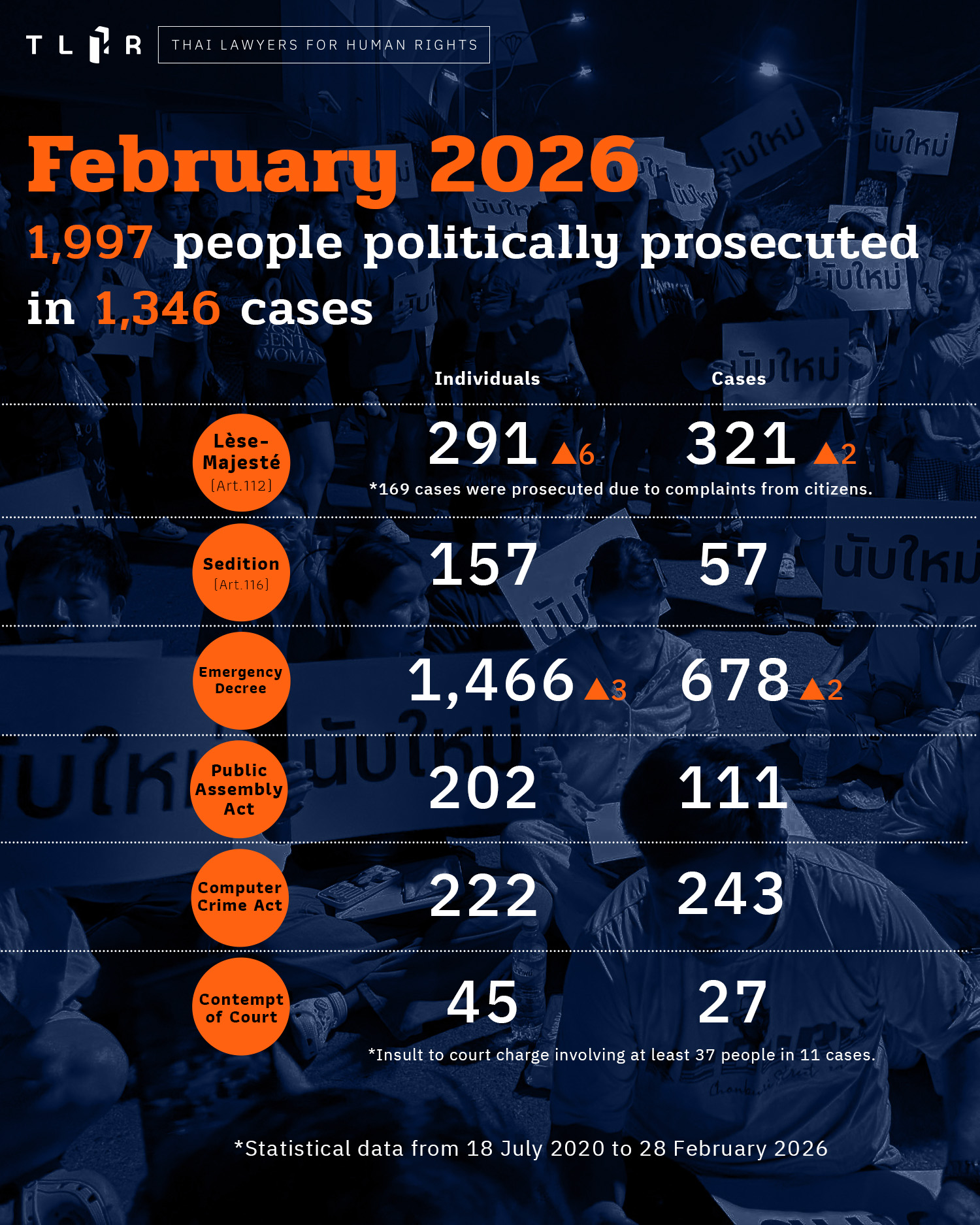
According to documentation by Thai Lawyers for Human Rights (TLHR), from the “Free Youth” assembly on 18 July 2020 through 28 February 2026, at least 1,992 individuals have been prosecuted in connection with public assemblies or the expression of political opinions, across a total of 1,346 cases. Compared to January 2026, this represents an increase of four additional cases.
In total, there have been at least 4,076 prosecutions when repeat cases are counted.
Prosecution statistics in key offences are as follows;
1. Section 112 (lèse-majesté) of the Criminal Code, at least 291 individuals in 321 cases (Of this, at least 169 cases have stemmed from reports to the police made by members of the public.) (six additional individuals in two additional cases in the past month)
2. Section 116 (sedition) of the Criminal Code, at least 157 individuals in 57 cases
3. Violation of the Emergency Decree, at least 1,466 individuals in 678 cases
4. Violation of the Public Assembly Act, at least 202 individuals in 111 cases (three additional individuals in two additional cases in the past month)
5. Violation of the Computer Crime Act, at least 222 individuals in 243 cases
6. Contempt of court, at least 45 individuals in 27 cases, and insult of the court, at least 37 individuals in 11 cases
Of 1,346 cases, 799 cases have reached their final verdicts (although some cases remain outstanding, since certain defendants decided to appeal the verdicts, while others have not).
.
Prosecution trend in February 2026 and key events;
The Election Commission presses charges against multiple citizens; TLHR finds an increasing trend of SLAPPs cases from politicians
Regarding the six additional individuals charged under two additional cases under Section 112, the first case concerns four Thammasat students, including “Friend,” “Maimoke,” and “Nong Pukpik” (pseudonyms) and another student. The four were charged under Section 112 and the Computer Crime Act, stemming from them allegedly holding up a banner parodying politics at Thammasat University Rangsit Campus, which had been accompanied by a post on the “Independent Group for Political Parody of Thammasat University” Facebook Page at the end of 2025. All four have acknowledged their charges back in January 2026, but the case has only recently been counted as a new addition to the statistics categorized by charges.
.
The second case concerned two red shirt protest leaders, including Phetcharawat Wattanapongsasirikul and Phayap Punkate. The two were prosecuted under Section 112 and charges of terrorism. These charges followed after the dispersion of the 2010 protests. In the past month, the Criminal Court acquitted the defendants of charges under Section 112, but convicted them on terrorism charges, sentencing each to 5 years in prison without suspension. Both individuals have been granted bail while their appeal is pending. This case has been counted as a new addition to the statistics.
.
Furthermore, there were three additional individuals in two additional cases under the Public Assembly Act. The first case concerns two protest leaders from The People and Student Network for the Reform of Thailand. Their charges stemmed from their participation in the protest rally at Phitsanulok Road back in February 2025, calling for the removal of Pol. Lt. Col. Thaksin Shinawatra and for him to be returned to prison. The charges were filed to the Dusit Provincial Court. The Court later sentenced them each to 1 month in prison without suspension. Both individuals have been granted bail while their appeal is pending. This case has been counted as a new addition to the statistics.
Another case concerned Chonticha Koomjanaad, a 27-year-old citizen who was arrested for serious violations of the Emergency Decree, stemming from a gathering at The Mall Bangkae on 20 October 2020. The police used an arrest warrant that had been issued nearly five years earlier, and later added a charge of failing to notify authorities of the assembly under the Public Assembly Act. However, this charge had already exceeded the statute of limitations.
.
Following the 2026 national election, it was found that at least two cases have been filed against citizens (only counting cases with a warrant calling for acknowledgement of charges or cases where the defendant has been arrested). The two cases are as follows:
The first case concerns ex-tennis instructor Tewa Sritawan. The defendant was arrested by police officers for throwing a bag of fermented fish against the walls of the Election Commission in protest against the lack of transparency of the election process. The defendant was charged under Section 389 of the Criminal Code for causing a filthy substance to defile property and create a nuisance. The case was settled at the police stage with a fine of 500 baht, bringing the matter to an end. The second case was filed against a citizen who was charged for posting a message.
Nevertheless, the past month also saw multiple cases of citizens who were charged in for reasons related to the national election, namely, the case of the Director of the Election Commission for Constituency 1 in Chonburi filing charges against three citizens, following their calls for a recount of election results in Constituency 1, Chonburi Province; and in another case where the Director of the Election Commission in Lampang filed charges against a citizen who posted a message about organizing a public forum on a referendum to amend the Constitution; as well as the most recent case where the Election Commission, filed charges against a total of six individuals—both citizens and members of the media—on charges under Section 116, criminal association, and the Computer Crime Act.
These cases will need to be monitored further to see whether the police will issue summonses for the accused to formally acknowledge the charges.
.
The past month also saw a situation where citizens in multiple areas received warrants from the Phayao Police Station to acknowledge their charges of “defamation through advertisement” under Section 328. Capt. Thamanat Prompow had authorized Athit Manassa to file police reports against citizens for sharing their opinions on Facebook through various formats.
In the past month, Thai Lawyers for Human Rights closely monitored the situation of “Thanoo” (pseudonym), a 30-year-old office worker from Bangkok who traveled to Phayao Police Station to acknowledge charges. Thanoo was additionally charged under Section 116 of the Computer Crime Act for additional edits of the image.
This situation calls for close attention to the use of defamation laws by politicians in areas where they hold influence, aimed at taking legal action against political rivals or citizens who criticize their background or performance. Such actions place a burden on the accused to fight legal cases and can impact freedom of expression. These cases may constitute Strategic Lawsuits Against Public Participation (SLAPP), a trend that appears to be increasing.
.
February 2026: Four cases under Section 112 resulted in imprisonment without suspension, resulting in “Vuttipat” and “Singto’s” imprisonment
Throughout February 2026, courts delivered rulings in at least six cases arising from public assemblies and political expression. These included four cases under Section 112 of the Criminal Code and two cases under other laws. All four cases under Section 112 resulted in a guilty verdict. The other two cases resulted in acquittals.
Of the four Section 112 cases in which verdicts were issued during the month, two were decided by the Court of First Instance, one was by the Court of Appeal and one was by the Supreme Court. The cases are summarized below:
In the case against Pruttikorn Sarakul or “Tonpai” who was accused of being the owner of a twitter account that made 10 posts concerning the monarch from November 2021 to March 2022, the Criminal Court issued a 3 year prison sentence for each post, totaling to a final verdict of 30 years in prison without suspension. During the day of the verdict hearing, the defendant did not travel to court.
Tonpai has faced a total of two cases under Section 112. In the previous case, the court sentenced Tonpai to 30 years in prison, before reducing the sentence by a third, resulting in a final verdict of 20 years in prison. The two cases total to 50 years in prison for Tonpai. This is considered another case in which the defendant has received a record-high prison sentence under Section 112.
In the cases against “Vuttipat” (pseudonym) who was charged for posting their opinion about King Rama VIII’s death in the “Royalist Marketplace” Facebook group back in 2 June 2020, the Supreme Court upheld the previous verdict, sentencing the defendant to 3 years and 4 months in prison. The court saw that the Region 1 Appeal Court’s interpretation of “the monarch” as encompassing past kings was already in line with the objectives of Section 112, resulting in the immediate conclusion of the case. The defendant was then transported to Samutprakan Central Prison for detainment.
In the case against “Singto” (pseudonym) who was charged for commenting under another Facebook user’s post, which featured an image of King Rama X and Crown Prince Dipangkorn, the Nonthaburi Provincial Court read the judgment of the Court of Appeal Region 1, sentencing the defendant to 1 year and 6 months in prison without suspension. Singto was then taken into custody while awaiting bail at the appeals stage. The Supreme Court later issued a rejection of Singto’s bail request, resulting in Singto’s continued detainment in Nonthaburi Central Prison.
In the case against six activists and citizens, including Arnon Nampa, Somyot Pruksakasemsuk, Pimsiri Petchnamrob, Nattathida “Waen” Meewangpla, Promsorn Veerathamjaree and Inthira “Sai” Jareonpura, stemming from thier participation in the #Mob29Nov20 protested in front of the 11th Infantry Regiment, all individuals received 10 charges, with core charges under Section 112 and Section 116 (with the exception of Inthira who received charges under Section 116 and the Public Assembly Act).
The Supreme Court sentenced Arnon, Somyot, Pimsiri and Promsorn each to 2 years and 8 months in prison without suspension for their charges under Section 112. The four defendants were each fined 10,200 Baht for violations of the Emergency Decree and unauthorized usage of speakerphones. Meanwhile, Nattathida was acquitted of her Section 112 charge, but was fined 10,200 Baht for violations of the Emergency Decree and unauthorized usage of speakerphones. Inthira was acquitted of all charges. Somyot, Pimsiri and Promsorn were granted bail during appeal, while Arnon continues to be imprisoned with a total prison sentence of 28 years 45 months and 20 days (approximately 31 years and 9 months). None of Arnon’s cases have received final judgments.
.
“Mooarm” acquitted, citing deserted military enlistment out of necessity; “New Sirawich” acquitted in 2019 Election Commission defamation case, citing just criticism
Concerning cases concerning public assembly and other forms of political expression, the court has issued verdicts in at least two cases. The details of the two cases are as follows:
In the case against Sergeant Aeknarongchai “Mooarm” Intharakawee, a former non-commissioned military officer, who was accused of deserting the military after filing a complaint about army allowance fraud, which led to a confrontation with his superiors in 2020. After five years of legal battle, the Bangkok Military Court acquitted him, ruling that although the defendant did commit the acts as alleged, his decision to flee and avoid punishment was due to a “necessity” to protect himself from danger. The danger was not caused by the defendant’s own wrongdoing, and his actions were deemed reasonable under the circumstances.
In the other case against Sirawit “New” Serithiwat, regarding his speech at an activity to collect signatures for the removal of the Election Commission on 31 March 2019, he was charged with defamation by public dissemination, with the accusation filed on behalf of the Election Commission. After more than seven years of legal battle, the Criminal Court acquitted him, stating that his actions were criticism of the Election Commission’s work aimed at promoting integrity, and therefore did not constitute defamation.
.
Schizophrenic patient “Pakpoom” charged under Section 112; “Fah” Promsorn and Direk charged remotely from Pattalung
In February 2026, it was found that prosecutors had filed at least four additional cases arising from public assembly and political expression. The details of the four cases are as follows:
The first case concerns “Pakpoom” (pseudonym), a 35-year-old Schizophrenic patient, who was charged at the Criminal Court under Section 112, Section 14(3) of the Computer Crime Act, and Section 54 of the Flag Act. The charges stemmed from allegations that he posted images and videos depicting stepping on and urinating on royal portraits, as well as urinating on the Thai national flag. Pakpoom was granted bail pending trial. However, he had previously been summoned by police without a warrant or lawyer and was temporarily detained over fears of fleeing, before Thai Lawyers for Human Rights intervened to provide legal assistance.
The second and third cases involve Promsorn “Fah” Veerathamjaree and Direk (surname withheld), who were charged under Section 112 for posting messages on Facebook criticizing a royalist group on 23 April 2022. The two cases were filed separately. The Pattalung Provincial Court granted bail to both defendants pending trial.
These two cases are notable as remote prosecutions, with Songchai Niamhom, a leader of the Protect the King Group, as the complainant. Both Phrommasorn and Direk had to travel from Bangkok to Phatthalung for their hearings.
The fourth case involves Chonticha Koomjanaad, who was charged at the Bang Bon District Court under the Emergency Decree for participating in a gathering near The Mall Bangkae on 20 October 2020. Last month, authorities arrested her under a warrant issued in March 2021. Previously, she had also been arrested in another case in 2023, but the police never presented the warrant at that time.
.
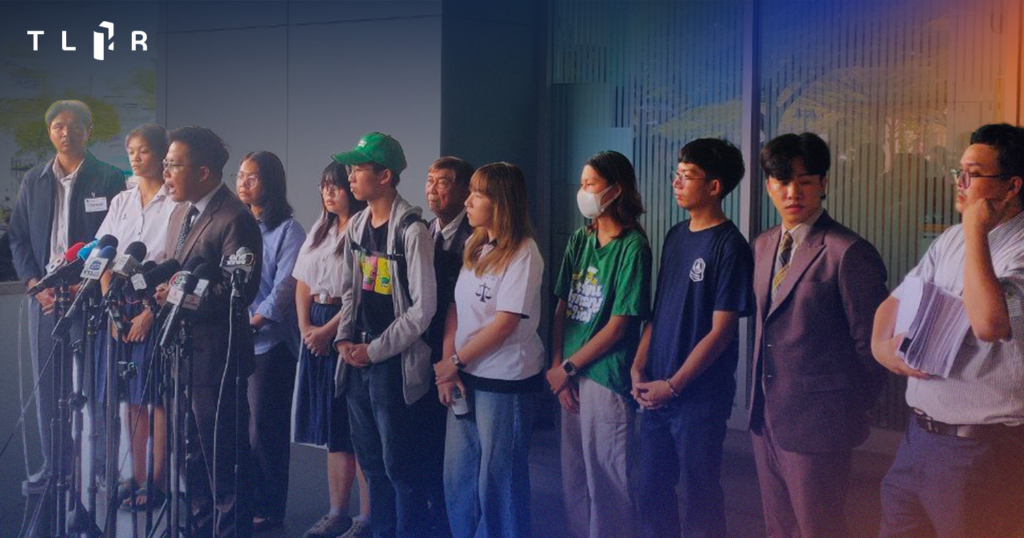
University students file charges at the Central Administrative Court on grounds that the Election Commission’s barcode ballot cards violate secret ballots principle
In the past month, a group of seven student representatives from several universities, together with lawyers, filed a lawsuit against the Election Commission and the Office of the Election Commission at the Central Administrative Court. The case challenges the design of ballots that included barcodes and QR codes, which allegedly allow votes to be traced back to individual voters. The students argue that this violates the principle of secret ballots and infringes upon the rights and freedoms of citizens.
The plaintiffs requested that the court issue an injunction prohibiting the Election Commission from using any codes that could identify or link back to individual voters in the preparation of ballots. They also asked the court to declare such ballots unlawful and urged the court to consider or issue an urgent order to prevent serious and irreparable damage.
At the same time, the plaintiffs requested the Administrative Court grant temporary relief, asking the court to suspend the announcement of election results until a final judgment or order is issued. They further requested that the court order the Election Commission to separate the ballot stubs from the voted ballots and seal the barcodes or QR codes on the ballots to prevent any tracing or linkage of information back to individual voters.
.
Court allows “Tantawan” to take off EM ankle bracelet after 1 year and 8 months of wear resulted in inflamed wounds
On 19 February 2026, lawyers sent a request to the Criminal Court to take off Tantawan “Tawan” Tuatulanon’s Electronic Monitoring (EM) ankle bracelet. The court had previously set the EM ankle bracelets as bail condition in the Tawan’s Section 112 case, which stemmed from a livestream in front of the UN Headquarters back in 2022.
Following the lawyer’s request, the Criminal Court allowed Tawan to take off her EM ankle bracelet on the condition of posting an additional bail of 150,000 baht; it was noted that the defendant showed no sign of attempting to flee. She attended the appointment to have the tracking device removed on 20 February 2026. This marked the end of more than 1 year and 8 months of wearing the electronic monitoring device, which had caused her ankle injuries, chronic skin inflammation, and difficulties with mobility.
However, according to monitoring by the Thai Lawyers for Human Rights, as of the end of February 2026, there were still at least 15 individuals facing charges related to political gatherings and expression who had been ordered by the court to wear EM bracelets.
Overall, counting from political protests starting in 2020, there have been at least 123 citizens or activists who were ordered to wear EM bracelets.

ข่าวหรือบทความที่เกี่ยวข้อง

Human Rights Situation Report January 2021
With the continuation of COVID 19-related restrictions in January, the authorities have developed legal mechanism for limiting any possibility of public demonstration, and persecuting dissidents on grounds of public health and safety violations. The well-being and political rights of Thai citizens remain gravely unprotected as the abuse of the “lèse-majesté” law is intensified, leading to […]

admin62
15/03/2564
“The courtroom has been made into a prison”: Defendants in the 19 September case declare withdrawal of legal representation
On 8 April 2021, a hearing to examine the evidence in the case of the #19 September Return Power to the People protest was held in Room 704 at the Criminal Court on Ratchadaphisek Road. The protest in question was held on 19- 20 September 2020 on the Tha Prajan campus of Thammasat University and […]

admin010
09/04/2564
First minor prosecuted with Thai lèse-majesté law in 2021
On 24 May 2021, the Central Juvenile and Family Court informed the lèse-majesté indictment dated 9 April 2021 to Thanakorn (surname withheld), aka Petch, a 17-year-old (as of the incident day) pro-democracy, LGBTQ+ human rights defender, making this the first case in Thailand to indict minors under the Article 112 of the Criminal Code (lèse-majesté […]
admin010
27/05/2564
[Analysis] Seven years after the coup: Lawsuits under the NCPO regime as “lawfare” (part 2)
The coup d’état on 22 May 2014 has left greater long-lasting legacies and enduring challenges for the resumption of democratic rule in Thailand than any previous coup over the past few decades. After the junta that launched the coup, the National Council for Peace and Order (NCPO) ruled the country for five years, one month, […]