
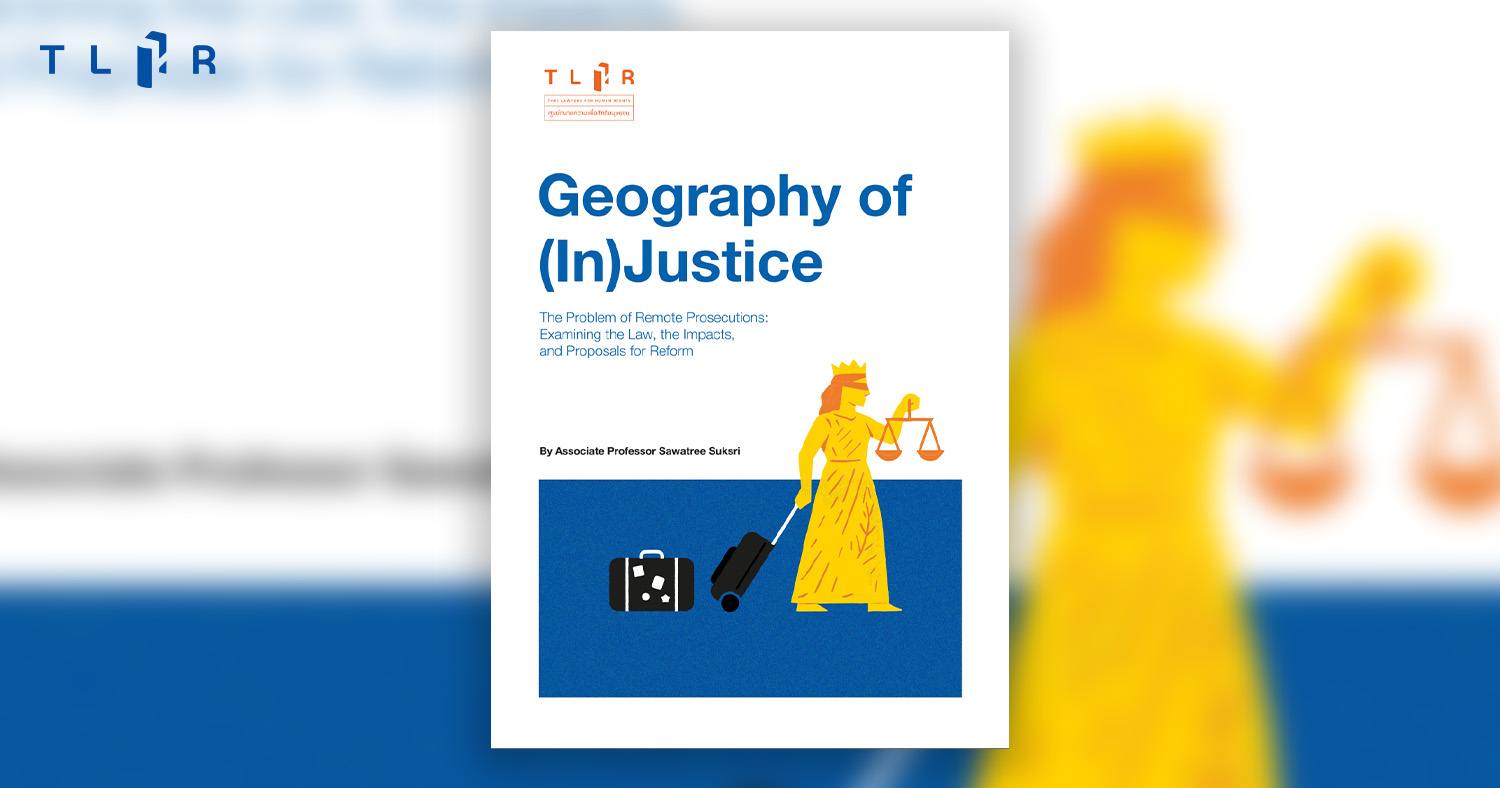
On 26 June 2026, Thai Lawyers for Human Rights (TLHR), the Center for Legal Studies at Thammasat University’s Faculty of Law, and the Legal Aid Center at Chulalongkorn University’s Faculty of Law held a launch event for TLHR’s new report, Geography of (In)Justice: The Problem of Remote Prosecutions: Examining the Law, the Impacts, and Proposals for Reform.
The report was prepared by Associate Professor Sawatree Suksri, a lecturer at Thammasat University’s Faculty of Law, in collaboration with Thai Lawyers for Human Rights. Drawing on case data collected by TLHR since 2020, the report examines the phenomenon of “remote criminal complaints and prosecutions” by analyzing the relevant legal issues, documenting their impacts, and proposing reforms to address the problem. It documents at least 66 cases since 2020 where criminal complaints or prosecutions were brought in localities far from the accused’s home. It argues that this practice serves less as ordinary law enforcement and more as a means of punishing people before any court has ruled on their guilt.
Methodology
Since 2014, TLHR has provided free legal assistance to people charged for exercising their rights to freedom of expression and peaceful assembly and has tracked the resulting cases in detail. Geography of (In)Justice draws on this case data, covering the period from 2020, when large-scale pro-democracy protests began, through October 2025. The dataset is limited to cases TLHR has monitored and legally assisted, mostly political in nature. It does not cover other categories of remote litigation in Thailand, such as environmental cases brought by businesses against communities. This limitation is treated as a strength rather than a gap because it isolates the use of venue as an instrument of power in the setting where that dynamic is clearest.
What Counts as a “Remote” Complaint
The report defines a remote complaint or prosecution as one brought in a locality with no meaningful connection to the accused’s domicile or to the facts of the case. Cases filed in a neighboring province or elsewhere within the same region are excluded from the count. The 66 cases identified involve complaints filed across regions, in some instances thousands of kilometers from where the accused actually lives. Examples include three Bangkok students reported to police in Chiang Mai over a photo taken at Siam Square, a Bangkok resident reported in both Yala and Chiang Mai over livestreams criticizing the monarchy, and a Koh Phangan resident summoned to Kamphaeng Phet over a TikTok clip.
Why Remote Prosecutions Are a Problem
The report’s central objection is that being prosecuted far from home causes real harm well before a court rules on guilt or innocence. A defendant is presumed innocent until then. Under Section 29 of the 2017 Constitution and Article 14(2) of the ICCPR, the state must not treat someone as guilty before that. However, when a complainant can choose a venue that imposes on the accused years of travel, lost income, and worsening health, that cost is incurred long before any verdict. The report calls this “punishment by process”: the accused pays regardless of how the case ends.
The same venue choice also undercuts equality of arms, the Article 14(3) guarantee that both sides get a genuine opportunity to prepare and present their case. A venue chosen for reasons unrelated to evidence or witnesses, but based on distance from the accused’s home and lawyer, puts the defense at a disadvantage before the case starts. The Nelson Mandela Rules make a related point for anyone detained during proceedings: they are entitled to regular contact with family and, where possible, to be held close to home.
None of this is an accident of drafting. Sections 18, 19, 22, 23, and 26 of the Criminal Procedure Code were written to give the state flexibility in prosecuting offenses connected to multiple localities, not to protect a defendant’s ability to respond. A defendant can ask for a transfer, but only after a case has been filed and the travel, costs, and disruption have begun. The rules allow geography to be used to punish speech, whether or not any official intends that result.
Legal Factors That Enable the Practice
The report attributes the pattern to specific features of Thai law rather than to individual misuse:
- Section 112’s status as an offense against the state means any member of the public may file a complaint without demonstrating personal harm or any connection to the locality where they file.
- The ambiguity of “place of offense” in online cases remains. Courts have interpreted content as having “occurred” wherever it can be viewed, which means anywhere in the country. The report cites Supreme Court Judgment No. 319/2560, which held that online content is accessible and actionable throughout the Kingdom.
- No mechanism screens venue selection before a complaint is accepted. Sections 18, 19, and 22 of the Criminal Procedure Code set where a case may be filed but do not require the choice to be reasonable or proportionate to the accused.
- Existing transfer mechanisms are weak and reactive. Section 23 permits transfer only to the location of the alleged offense, not to the accused’s domicile. Section 26 requires the accused to show a risk to public order, not just personal hardship.
- The Royal Thai Police Regulation on the Transfer and Consolidation of Cases B.E. 2565 (2022) is, according to the report, the most workable existing tool because it can transfer an investigation before a case reaches court. However, it remains discretionary, non-binding on prosecutors and courts, and has been refused in some cases without any appeal option.
The Data: Charges and Complainants
Of the 66 cases identified, the charges concentrate heavily on a single provision: Section 112 of the Criminal Code (lèse-majesté), charged alongside the Computer Crime Act, which accounts for 53 cases, or 80 percent. The remaining 13 cases are split between Section 116 (sedition), the Computer Crime Act alone, and defamation or insult by publication.
| Charge | No. of Cases | Proportion |
| Section 112 + Computer Crime Act | 53 | 80% |
| Section 116 + Computer Crime Act | 3 | 5% |
| Computer Crime Act alone | 4 | 6% |
| Defamation/insult by publication | 6 | 9% |
The complainants show a similar concentration. More than 60 percent of cases were filed by monarchy-protection groups and networks or by unaffiliated individuals who filed two or more cases each. Both categories monitor online content and file complaints far from their own location. Another 16 percent were filed by individuals bringing a single case. The rest were brought by state agencies, usually centralized at the Technology Crime Suppression Division in Bangkok, and by politicians filing in provinces that are their political strongholds.
The report treats the concentration under Section 112 as significant itself. Since the offense is against the state rather than a specific victim, any member of the public may file a complaint without a personal connection to the accused or the alleged conduct. Thai law allows a case to be filed wherever the offense is considered to have taken place. Courts have interpreted online content as taking place wherever it can be viewed, which means anywhere in the country. These two features make Section 112 unusually easy to bring far from where the accused lives.
The Human Cost
The report traces the cumulative burden remote prosecutions place on the accused across several dimensions: legal counsel, finances, family life, and physical and mental health.
Access to counsel. Remote cases often force lawyers to travel long distances, raising costs and pushing the accused toward unfamiliar local counsel or, in some cases, to appear without a lawyer. “Nakhon,” a university student, was arrested without counsel present and held for 10 days at Samut Prakan Central Prison before the charges against him were later dismissed.
Economic impact. Cases can last two to three years or longer, which can mean lost income from time off work, a pause in schooling, or a business left unattended. “Kanlaya,” a 27-year-old woman from Nonthaburi, was one of more than 20 defendants swept into a single Section 112 cluster filed at Su-ngai Kolok in Narathiwat. She had to travel across the country each time she had to acknowledge charges or appear in court.
Family impact. Some defendants were their family’s primary breadwinner or caregiver. Remote cases pulled them away from those responsibilities. “Chatmongkhon,” a security guard, was summoned as far as Chiang Rai while caring for his mother and grandmother.
Health impact. Long-distance travel and the demands of ongoing legal proceedings can significantly impact physical and mental health, especially for defendants with pre-existing conditions. “Chaichana,” who has schizophrenia, was arrested and detained over 1,800 kilometers from home in Su-ngai Kolok and required a guardian for each court appearance. “James Natthakarn,” who was being treated for depression, did not receive his medication while detained in Phatthalung, which led to a deterioration in his condition.
A Political Instrument
An ordinary criminal complaint comes from someone personally harmed who reports the case near where they live or where the harm happened. The report finds this is often not the case in these remote complaints. Instead, a small number of individuals and monarchy-protection groups file complaint after complaint. In some years, a single complainant filed five to ten cases at once from the same police station against people who have never met and share nothing except posting something political online. The report calls these stations “case production hubs.”
That pattern matters because it does not look like someone seeking justice for a personal injury. It looks like a method. File in a location far from the accused, then let the process itself do the work: the travel, the lost income, the time spent navigating an unfamiliar court. All of that lands on the accused whether or not the case is ever won.
The report compares this to Strategic Lawsuits Against Public Participation, known as SLAPP suits. A SLAPP is typically a civil lawsuit filed not to win in court, but to wear someone down and pressure them into silence through the cost and stress of defending themselves. Many countries have built legal safeguards against SLAPPs into their civil law, but Thailand has no equivalent protection in criminal law. The report argues that the same tactic is being carried out through criminal prosecution instead, where the accused has even fewer protections than a defendant would have in a civil cases.
Report Recommendations
Since remote prosecution is built into how Thai criminal procedure allocates jurisdiction, the report’s recommendations target that structure directly rather than individual misuse of it.
Geography of (In)Justice closes with six recommendations:
- Technological Measures to Mitigate Harm During the Transitional Period. Remote-conferencing technology should be expanded as a right of the accused for stages that do not require physical presence.
- Adopt a Restrictive, Fair-Trial–Compatible Interpretation of “Place of Offense” in Online Criminal Cases. Courts should stop treating mere accessibility of online content as sufficient to establish jurisdiction, and instead require a substantial connection between the venue and the offense.
- Establish Clear Legal Controls on “Venue Selection” for Complaints and Prosecutions Under Criminal Procedure. The Criminal Procedure Code should require officials to justify venue selection based on a genuine connection to the offense, the burden on the accused, and whether a less burdensome venue exists.
- Develop a “Pre-Acceptance” Screening Mechanism to Prevent Bad-Faith Remote Prosecutions. Courts should be able to assess whether a chosen venue is disproportionately burdensome, and prosecutors should have to justify venue selection in writing.
- Elevate “Defendant’s Domicile” as a Rights-Based Ground, Not Merely a Jurisdictional Option. Section 23 should let defendants request transfer to their home court where the original venue imposes a disproportionate burden on their defense.
- Strengthen the Royal Thai Police Regulation on Case Transfers to Provide Rights-Based Protection. The accused’s right to a fair defense should become a binding ground for transfer under the police regulation, with written reasons and a review mechanism for refusals.
ข่าวหรือบทความที่เกี่ยวข้อง

January 2015: Hearing schedule of five cases assisted by TLHR
Press Release January 2015: Hearing schedule of five cases assisted by TLHR During the latter half of January 2015, there are five cases handled by the Thai Lawyers for Human Rights (TLHR) to go on trial including; PDRC demonstration site bombing in Trat province (Black Case no. O1213/2557, Trat Provincial Court) Prosecution witness examination […]

Thai Lawyers for Human Rights
19/01/2558 Press Release A Wolf’s Bride verdict to be delivered at the Bangkok Criminal Court at 13.30 on 23 February
For immediate release on 20 February 2015 Press Release A Wolf’s Bride verdict to be delivered at the Bangkok Criminal Court at 13.30 on 23 February On Monday 23 February at 13.30, the Criminal Court is going to deliver a verdict on the Black Case no. 3528/2557 filed by the public prosecutor against Mr. Patiwat […]

admin
20/02/2558 Public Statement Condemning Bomb Attacks in Southern Thailand, Demanding Fair Trial Rights and Transparent Investigation
Public Statement Condemning Bomb Attacks in Southern Thailand, Demanding Fair Trial Rights and Transparent Investigation During 11-14 August 2016, 17 explosions took place in seven provinces in Southern Thailand causing a number of lives and damages. Since 13 August 2016, the Thai authorities have responded by invoking Section 44 of the Constitution of the […]

TLHR
15/08/2559
A roundup on 28 April: Eight alleged admins of Facebook pages raided and held in custody at the CSD, Criminal Court to deliver an order on the habeas corpus case at 10.00am on 29 April
There were two developments on 28 April 2016. First, relatives of the persons held in custody have gone to the Bangkok Criminal Court to file a complaint asking the Court to review the lawfulness of the detention and to have them released from custody. The Court will deliver the verdict on 29 April at 10.00am. […]