
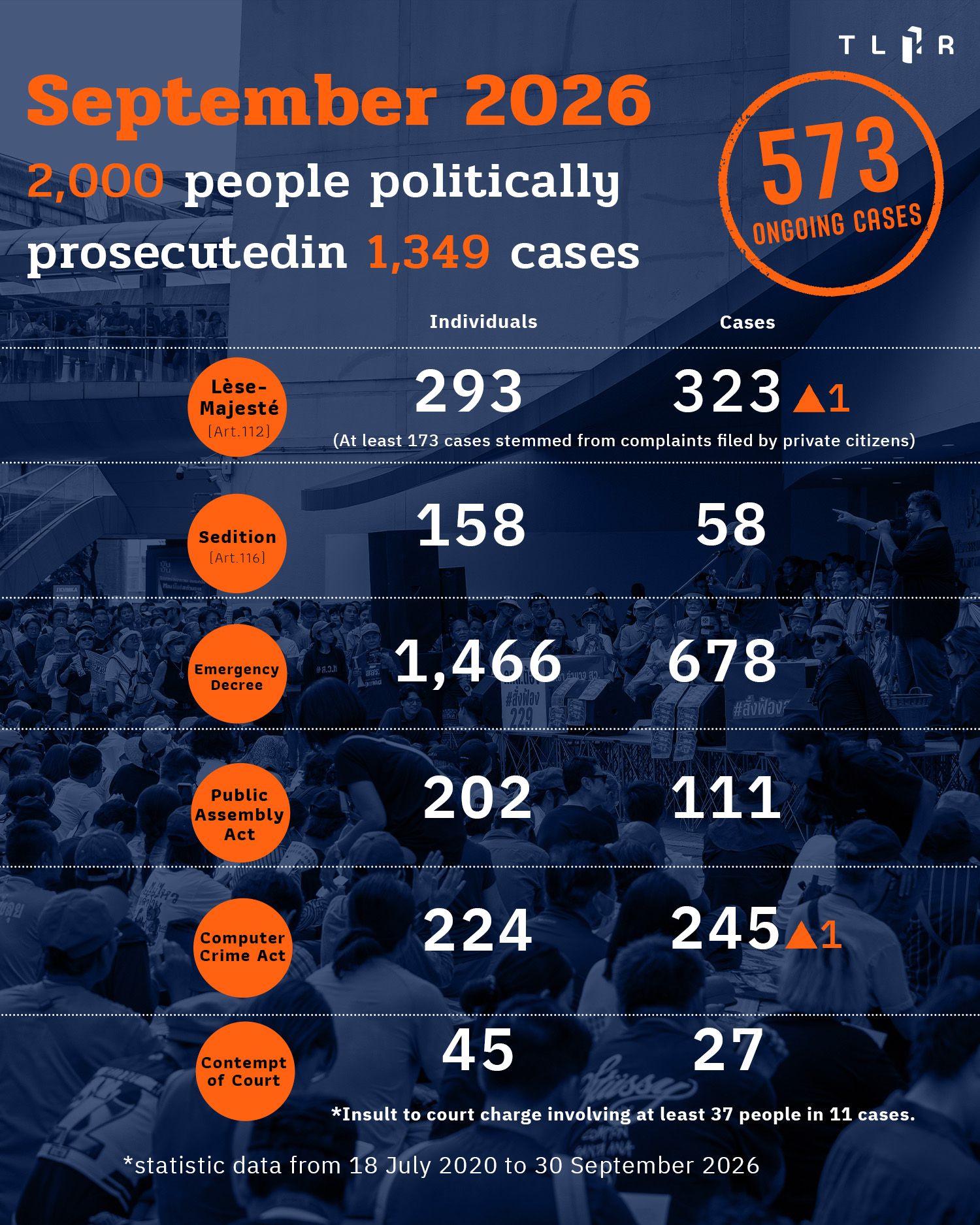
In September 2026 one more political case was added: the Section 112 and Computer Crimes Act case against Tiwagorn Withiton, who has only now learned that he was charged in a new case while in prison, in connection with five Facebook posts made in July 2022. The complainant is Sonthiya Sawasdee. This case brings Section 112 totals to at least 293 people in 323 cases.
Over the past month the courts also delivered judgment in at least one case: the Section 112 case against “Pai” Jatupat and “Khru Yai” Attapol in which the Supreme Court upheld prison sentences of two years and 12 months (three years) and of two years respectively. Their cases have thereby concluded, and both are now serving final sentences.
Over the past month seven prisoners whose cases had concluded were released in all. One was released on completing his sentence: “Areef” Weerapap, a prisoner in a Section 112 case. Six were released under the amnesty: (1) Nisit Sinthuprai, (2) Noppon Namchiangtai, known as “Tae Mod Daeng” and (3) Somyot Phrompha, from the group of prisoners in the 2009 Red Shirt cases; and (4) “Bas” Prawit, (5) Kachen, and (6) Khajonsak (surnames withheld), from the group of prisoners in the 2021 Thalu Gas assembly cases. Meanwhile, bail applications were filed for four detainees whose cases are still being tried, and the courts denied all of them.
As for the amnesty under the Peaceful Society Act, the courts have begun to order the termination of pending cases—at least six so far—and the public prosecutor has issued a non-indictment order in one case. In considering applications to release detainees who meet the amnesty criteria, however, each court continues to follow its own practice, making different orders. At least six detainees who meet the criteria are still awaiting release.
.
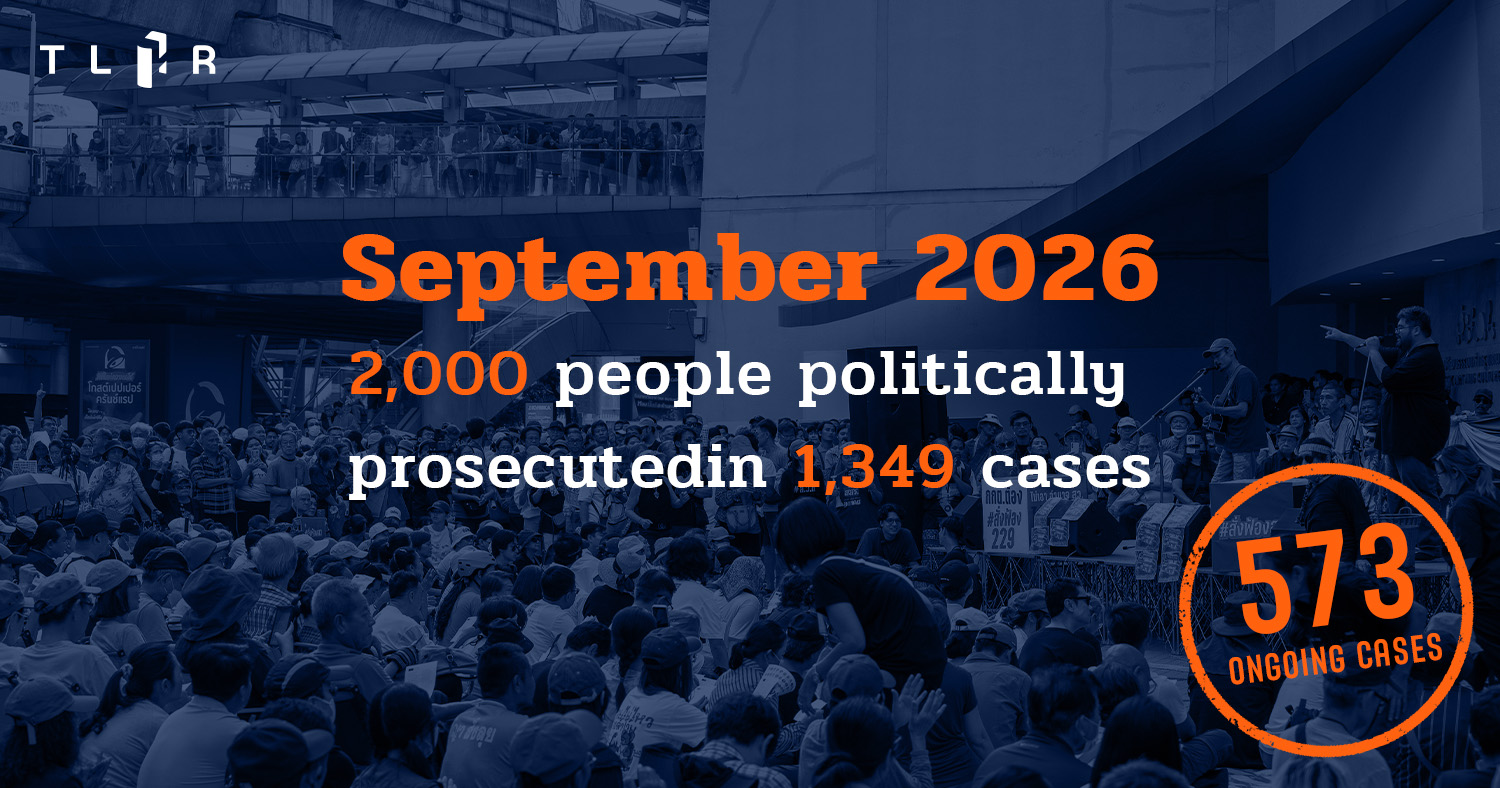
According to Thai Lawyers for Human Rights’ documentation, from the start of the “Free Youth” assembly on 18 July 2020 until 30 September 2026, at least 2,000 people have been charged and/or prosecuted for exercising assembly and political expression, in 1,349 cases.
Compared to August 2026, the number of cases has increased by at least one. (This figure counts only cases arising from public assembly and political expression in which the individuals have already been notified of the charges, and does not count defamation suits brought by politicians against members of the public in various provinces.)
Counting each criminal case separately, without deducting people charged and/or prosecuted in more than one case, the total comes to at least 4,079 instances of criminal proceedings.
Statistics are as follows:
1. Section 112 (lèse-majesté) of the Criminal Code—at least 293 people in 323 cases, of which at least 173 were brought following complaints lodged by members of the public. (One more case than the previous month, while the number of individuals charged is unchanged.)
2. Section 116 (sedition) of the Criminal Code—at least 158 people in 58 cases.
3. Violation of the Emergency Decree—at least 1,466 people in 678 cases.
4. Violation of the Public Assembly Act—at least 202 people in 111 cases.
5. Violation of the Computer Crimes Act—at least 224 people in 245 cases. (One more case than the previous month, while the number of individuals accused is unchanged.)
6. Contempt of court—at least 45 people in 27 cases; and insulting the court—at least 37 people in 11 cases.
Of those 1,349 cases, 846 have concluded. (Some cases have not concluded in their entirety—for example, where an appeal has been brought on behalf of only some defendants while the cases against others have concluded—and cases struck out by the court are not counted.) That is to say, at least 573 cases remain ongoing and are at various stages of proceedings.
.
Tiwagorn charged in a further Section 112 case while in prison over five Facebook posts; Sonthiya named as complainant
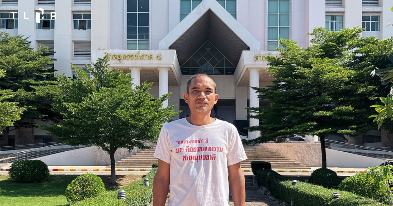
Tiwagorn Withiton is a prisoner whose Section 112 case has concluded, after the Supreme Court upheld a six-year prison sentence over a post of photos of him wearing a shirt reading “We have lost faith in the monarchy” as well as posts calling on the monarchy to stop using Section 112 and to release four Ratsadon leaders.
While Tiwagorn has been held at Khon Kaen Central Prison, it has only now emerged that on 22 July 2026 police charged him under Section 112 in a further case, inside the prison, over five Facebook posts made in July 2022. The complainant is Sonthiya Sawasdee.
His lawyer, Phattana Sriyai, said that when inquiry officials from the Technology Crime Suppression Division (TCSD) came to notify Tiwagorn of the charges, accompanied by a lawyer from the Lawyers Council of Thailand, he refused to give a statement and refused to sign the acknowledgment of the charges. He said he felt “disgust” and “wanted to vomit,” and did not want to take part in a process so lacking in fairness and justice. Details of the case are still being obtained from the agencies concerned.
Supreme Court upholds prison sentences of two years and 12 months on “Pai” and two years on “Khru Yai” over Phu Khiao speeches, interpreting Section 112 as protecting every monarch of the Chakri Dynasty
Throughout September 2026 courts delivered judgment in at least one case arising from public assembly and political expression: the Section 112 case against “Pai” Jatupat and “Khru Yai” Attapol. In addition, because the Act on Promoting a Peaceful Society B.E. 2569 (2026) has come into force, courts have ordered the termination of some of the assembly and political expression cases that fall within the amnesty, while applications to terminate others are still under consideration. As a result, cases that had been scheduled for judgment over the past month were postponed.
The Section 112 case against “Pai” Jatupat and “Khru Yai” Attapol arose from speeches that they gave advocating for the reform of the monarchy at a public assembly in front of Phu Khiao School and Phu Khiao Police Station, Chaiyaphum province, on 1 February 2021.
On 30 September 2026 the Supreme Court upheld the judgment of the Court of Appeal Region 3, sentencing Pai to two years and 12 months in prison (three years) and Khru Yai to two years. The Court ruled that Section 112 protects the institution of the monarchy, extending to both the reigning King and every past King of the Chakri Dynasty.
The judgment brings the case to its conclusion, after more than five years and through three levels of court. As this was the decision of the Supreme Court, both are now serving final sentences. Although both had earlier been granted bail at the Supreme Court stage, the courts refused bail in other cases in which they had withdrawn their own bail and were held under detention warrants. Therefore, both are still in detention.
Read more > Statistics on Section 112 cases in which the courts have given judgment
.
Political prisoners released—six under the amnesty law, and on completion of sentence—while the courts continue to deny bail to detainees whose cases are still being tried
In September 2026 bail applications were filed for four detainees whose cases are still being tried, and the courts denied all of them. Meanwhile, six prisoners whose cases had concluded were released in all, under the amnesty and on completion of their sentences.
Of the bail applications, three were in Section 112 cases: Attapol Buapat, Nawat Liangwattana and Jatupat Boonpattararaksa. The courts denied bail in every case, even though these were cases in which they had themselves applied to withdraw bail while detained in their principal cases. Attapol and Jatupat had since been granted bail in the principal cases in which they were held, but the Supreme Court then upheld their prison sentences, making them prisoners serving final sentences at once. Nawat remains detained in the case in which he withdrew his own bail, even though he has served his full sentence in the principal case.
It was also reported that the sixth bail application was filed for Aekachai Hongkangwan, a detainee in a Section 110 case. The Supreme Court once again denied his bail request.
Of the seven prisoners released after their cases had concluded, one was released on completing his sentence: “Areef” Weerapap Wongsamarn, a prisoner detained under Section 112 case over spray-painting messages calling for reform of the monarchy near Din Daeng Intersection during an assembly in 2021.
The other six were released after being granted amnesty under the Act on Promoting a Peaceful Society: three in connection with the 2009 Red Shirt cases, including (1) Nisit Sinthuprai, (2) Noppon Namchiangtai also known as “Tae Mod Daeng,” and (3) Somyot Phrompha, and three in connection with the 2021 Thalu Gas assembly cases, (1) “Bas” Prawit, (2) Kachen and (3) Khajonsak (surnames withheld).
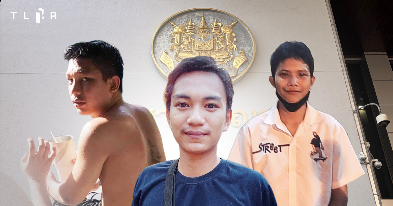
Meanwhile, at least six detainees who meet the amnesty criteria are still awaiting release: (1) “Wichit” (pseudonym), (2) “Khunphaen” Chen Chiwa-abancha, (3) Ngoenta “Manee” Khamsaem, (4) Jiratchaya “Jinny” Sakulthong, (5) Phichai (surname withheld), and (6) “Peerapong” (pseudonym). All are awaiting court orders. In the case of “Jinny,” the Bangkok South Criminal Court has ordered to await for a reply letter from the Committee for Promoting a Peaceful Society.
.
Examining amnesty under the Peaceful Society Act: courts begin, case by case, to strike out pending cases
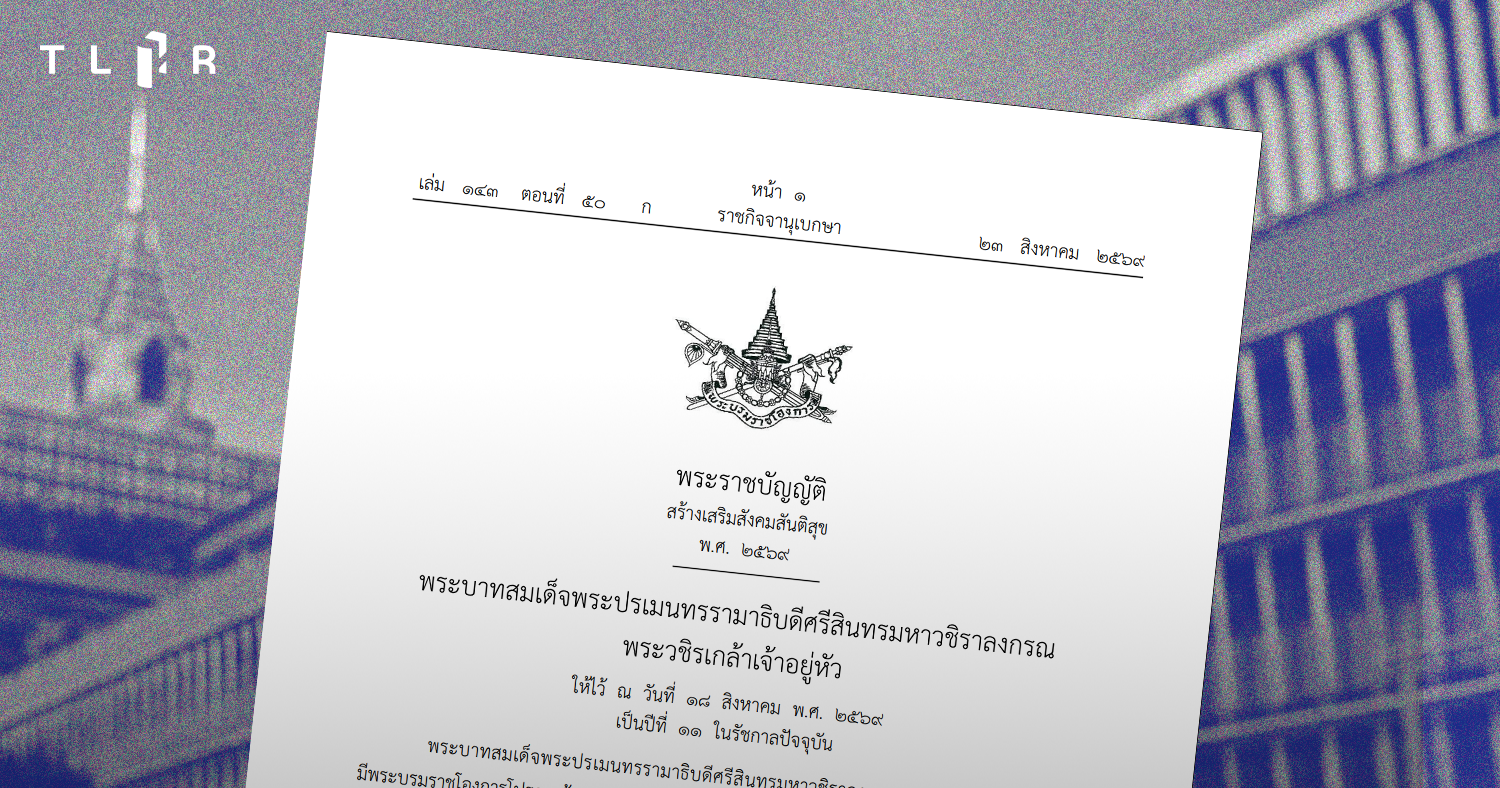
The Act on Promoting a Peaceful Society came into force on 24 August 2026, granting amnesty in political cases for assembly or expression arising from political conflict or political motivation that took place between 1 January 2005 and 16 July 2025. However, the Act excludes offenses under, inter alia, Section 112 and grievous bodily harm.
According to Thai Lawyers for Human Rights’ documentation, from the date in which the Act came into force and 30 September 2026, Thai courts have ordered the termination of proceedings in at least six cases:
- the #Mob16AugToToppleTyrants case of 2021;
- the “Sadoed Convoy” car mob case of 2021;
- the case over the P-Move assembly in front of Government House in 2025;
- the case over the #PmoveReclaimingRights assembly beside Government House in 2024; and
- the #Mob6Oct21 assembly case.
All these cases were pending before Courts of First Instance.
In addition, in at least three cases the courts struck out only those charges that meet the amnesty criteria, excluding Section 112: the (1) #19SeptToReclaimPowerOfRatsadon case, (2) the #25NovGoToSCB case, and (3) #26OctToGermanEmbassy assembly cases of 2020. Other cases in which applications have been filed are still awaiting court orders.
In terms of implementation, courts have adopted different practices, procedures, timing, and outcomes. The overall trend, however, is that courts are moving towards the same direction: Courts of First Instance tend to strike out eligible cases quickly. However, cases before the higher courts, cases that have concluded tend to result in additional steps, such as sending the application to the plaintiff for comments, scheduling an inquiry hearing, or sending the case file to a higher court to rule on.
The Bangkok South Criminal Court has adopted a very different practice. At first its practice was to send every application to the Committee for Promoting a Peaceful Society to determine, regardless of the level of court the case was before. It subsequently changed course and terminated proceedings immediately—in the #26OctToGermanEmbassy assembly case—after the Supreme Court issued a letter setting out guidelines for practice. Afterwards, however, in the case of “Jinny”, the court again ordered to await the Committee’s determination letter.
Regional courts, such as the Pattani Provincial Court, have also shown differences in some cases. In the mock referendum activity case, where witness examination had concluded only a few days before the Act came into force, the court decided to await the outcome of the Committee’s consideration. In the Malayu Raya case, the plaintiff objected to the application to strike out the case, so the court ordered the matter sent to the Committee to determine first.
As for cases still with the public prosecutor, the prosecutor has now ordered the termination of proceedings in one case: the #ChiangMaiWillNotTolerate assembly of 2020 in which 38 individuals were accused under the Emergency Decree. Other cases in which applications have been filed are still awaiting orders.
Read back > Progress on amnesty? Looking at results and issues one month after the Peaceful Society Act came into force
.
Prosecutor declines to indict four Chiang Mai activists in Section 116 case brought by the military over a reading of the People’s Party (Khana Ratsadon) declaration at the “Democracy Prop” parade
In September 2026 Thai Lawyers for Human Rights received a non-indictment order issued by the Chiang Mai Provincial Public Prosecutor in the case against four students and activists—(1) Chatchai Thammo, (2) Watcharaphat Thammachak, (3) Theeraphon Phutthasi, and (4) Benjaphat Thongnanta. Military officials had accused them on a principal charge under Section 116 over the activity “Parading the Democracy Prop, Pinning Down Decentralization” at the Three Kings Monument on 24 June 2023. The prosecutor took the view that the activity was a peaceful public assembly without weapons, which is protected under the Thai Constitution.
As for their reading of the declaration of the People’s Party (Khana Ratsadon), the matter concerned historical political events; it has been publicly disseminated and is accessible to the general public; it is not prohibited or an offense in law; and there is no indication that the facts were altered or distorted from the text of the declaration.
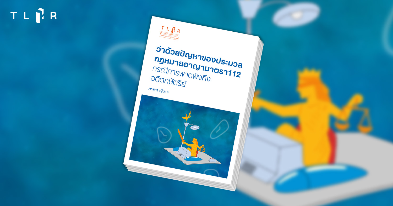
Read the study “On the Problems of Section 112 of the Criminal Code in Cases Referring to Former Kings”
On 2 September 2026 Thai Lawyers for Human Rights, together with the Research Centre for Law and Develop of the Faculty of Law, Chiang Mai University, launched the report “Issues Concerning the Application of Section 112 in Cases Involving References to Former Kings.”
The report finds that the case law reflects a significant shift in the interpretation of Section 112. In some cases, Courts of First Instance adopted an approach that limited the scope of Section 112, holding that the provision does not directly protect former Kings. However, when these cases reached the Courts of Appeal or the Supreme Court, the direction of the rulings shifted toward accepting that Section 112 can extend to former Kings. These rulings relied on considerations relating to the institution of the monarchy, national security, the continuity of the dynasty, royal succession, the King’s royal duties, and the impact on public sentiment.
Expanding the scope of the offence through judicial interpretation in this way has serious implications for fundamental principles of criminal law, particularly the principle that criminal laws must be strictly construed and the principle of legal certainty. It makes the scope of the offence unclear and unpredictable. It also risks shifting the role of criminal law from protecting rights and freedoms toward becoming a tool for expanding state power to control the expression of opinions, and even to define and interpret history.
ข่าวหรือบทความที่เกี่ยวข้อง
The Court of Appeal denied a request to release 4 protest leaders, citing their speeches have tarnished the reputation of the monarchy, despite the lack of final verdict
On 15 February 2021 at 16.30 approximate, The Criminal Court read the order of the Court of Appeal to deny bail requests of 4 protest leaders of the “Ratsadon Group”, which is in accordance to the Court of First Instance. After 11 February 2021, the lawyer filed an appeal against the Court’s order denying bail […]

admin62
19/02/2564
Human Rights Situation Report January 2021
With the continuation of COVID 19-related restrictions in January, the authorities have developed legal mechanism for limiting any possibility of public demonstration, and persecuting dissidents on grounds of public health and safety violations. The well-being and political rights of Thai citizens remain gravely unprotected as the abuse of the “lèse-majesté” law is intensified, leading to […]
admin62
15/03/2564
“The courtroom has been made into a prison”: Defendants in the 19 September case declare withdrawal of legal representation
On 8 April 2021, a hearing to examine the evidence in the case of the #19 September Return Power to the People protest was held in Room 704 at the Criminal Court on Ratchadaphisek Road. The protest in question was held on 19- 20 September 2020 on the Tha Prajan campus of Thammasat University and […]

admin010
09/04/2564
Numbers of political detainees being held in detention during investigation or pending trial in 2021
According to the TLHR database (8 June 2021), at least 2 individuals have been detained after Thai courts rejected their requests for temporary release or bail. All of the cases stem from their political expression and assembly. Among these numbers, there are: 0 individuals who were prosecuted for allegedly violating Article 112 of the Criminal Code […]