
Story and Photos Veerapong Soontornchattrawat
.
Note: This interview series is part of the book “Feathers on the Scales”, which features ten interviews that explore the lives and experiences of human rights lawyers advocating for civil and political rights in Thailand. The book was published by Thai Lawyers for Human Rights (TLHR) in February 2025 and was later translated into English.
——————————
.
“We must search for the truth and bring it to the public to defend the accused. It is the duty as a lawyer to determine whether what the defendant said was intended for the public good.”
.
When the hour hand pointed to twelve, the sound of a pendulum clock hanging on the wooden wall echoed throughout the office occupied by fellow lawyers. On the other two walls were two more clocks. One was designed in a style popular in the 1980s, bearing the word ‘RHYTHM’ on its face. The other was modeled after the symbol of Khana Ratsadon (People’s Party plaque), and marked with the words ‘Dawn of June 24, 1932’–a historical artifact of the country’s revolution that had disappeared from the ground of the Equestrian statue of King Chulalongkorn several years ago.
“The clock rings every hour,” Ratsada Manuratsada informed the visitor. “Will it disturb your interview?”
I replied to the senior lawyer that the sound of the clock wasn’t a problem, but the noise from the water pump, which echoed every time someone used it, might interfere with the recording of both video and audio. He then informed the household members to temporarily turn off the pump. As a result, the law office which also served as the family’s residence fell into a quiet stillness, as if the entire space was leaning in to listen to the life and experiences of this lawyer.
Lawyer textbooks and plaques honoring Lawyer Ratsada’s achievements were displayed in a glass cabinet as evidence of his 40 years of service to society. On a wooden shelf stood a figure of Mahatma Gandhi, placed alongside photographs of three prominent figures: Ho Chi Minh, Pridi Banomyong and Buddhadasa Bhikkhu. These framed portraits of iconic individuals quietly reflected the identity and values of the man who lived here.
Pradub and Associates Attorney Office was founded in 1978 by Pradub Manuratsada, the late father of Lawyer Ratsada. However, its reputation and honor continue to live in the hearts of the later generations.
“I started paying attention to news about the country during my high school years. After graduating from high school, I was determined to study law at Ramkhamhaeng University, with the intention of becoming a lawyer like my father,” said Lawyer Ratsada.
In the later years of Lawyer Pradub’s life, he continued to handle important cases, particularly land disputes involving farmers in the northern region. “That was the time when my father passed on his knowledge and experience as a lawyer to me,” said Ratsada.
Lawyer Pradub was a prominent figure in Thai society. He took on cases for many human rights organizations. Pradub and Associates Attorney Office provided legal assistance to the public in cases involving human rights violations, children’s rights, women’s rights, political offenders, and land disputes in several provinces. The office served as a training ground for a new generation of lawyers committed to serving society, including Lawyer Pradub’s son.
.
.
Seven years after his father established the law office and began handling both general cases and cases supporting the public, Ratsada began his career as a lawyer in 1985. At that time, he was still a young lawyer, but by the end of October 2024, time and experience had shaped him into a senior lawyer.
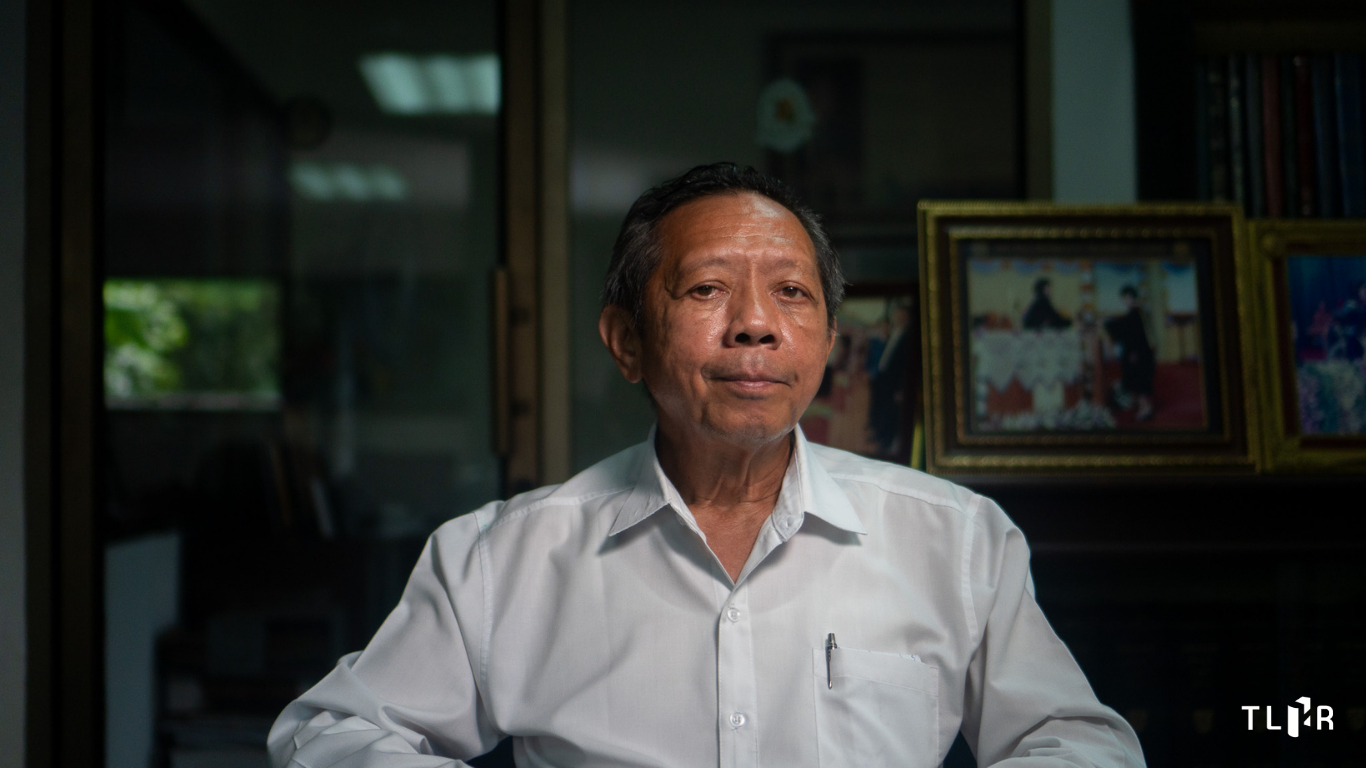
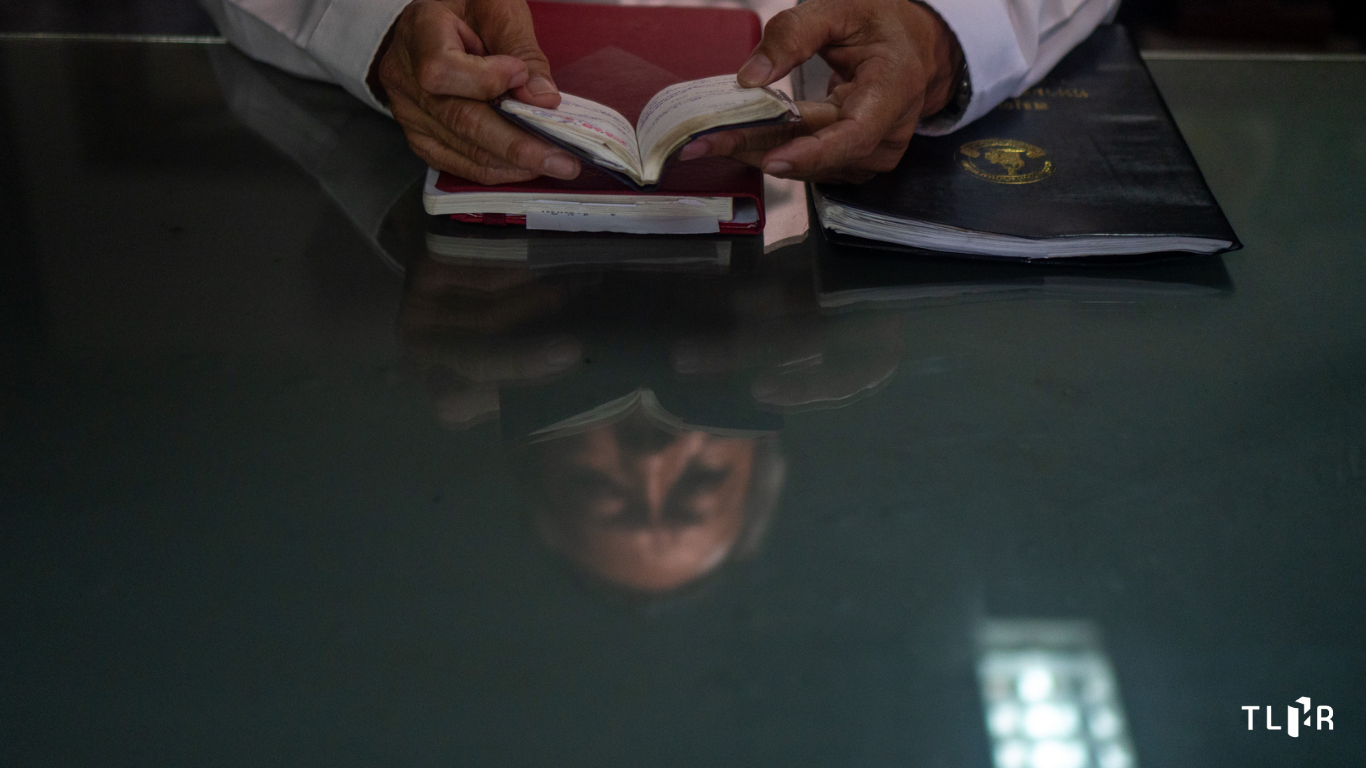
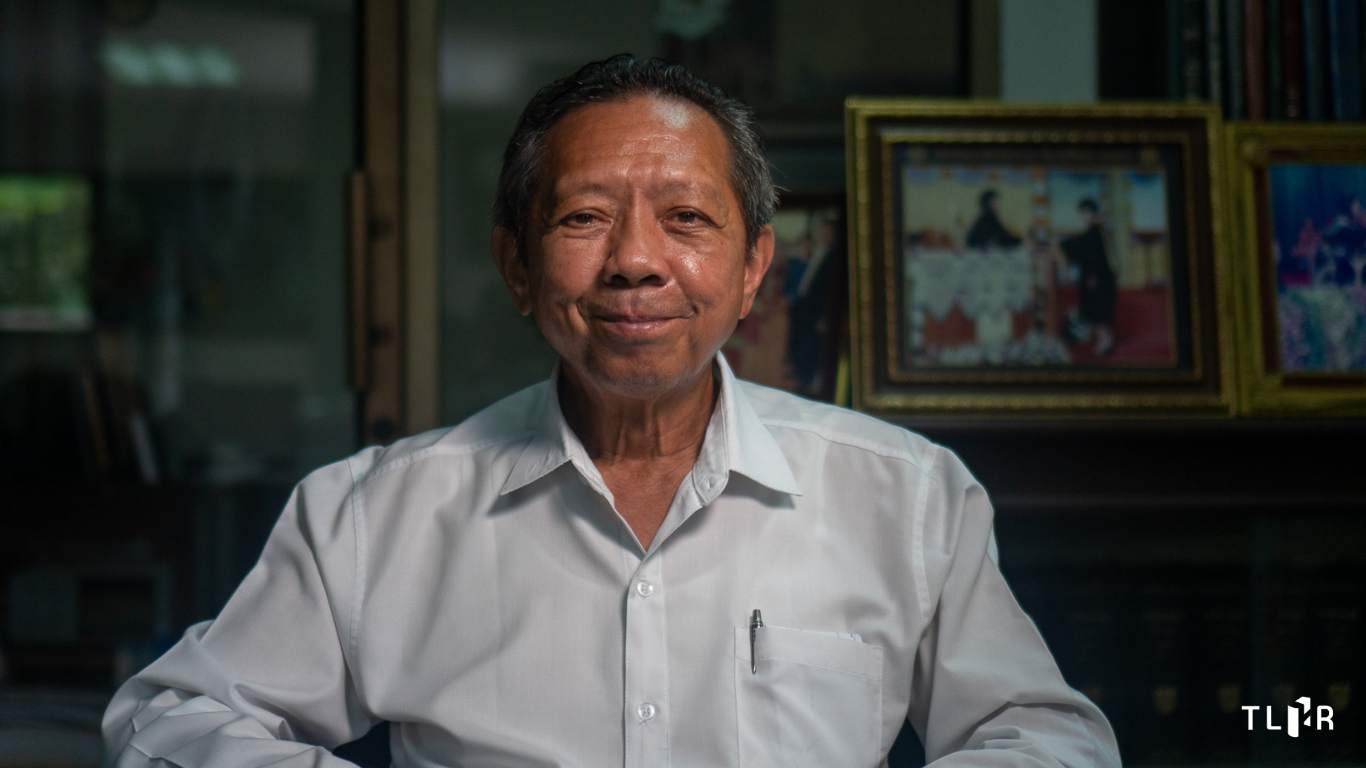
Lawyer Ratsada wore a white shirt tucked into navy blue slacks. His shirt was neatly pressed, the crease on his slacks sharp and clean. His hair was neatly combed into place, a pen clipped to his shirt pocket, and a small notebook lay on the table.
“A lawyer is like a new mother,” Lawyer Ratsada said. “Being a lawyer requires delicacy and attention to detail. You can’t be careless and superficial. If you’re scheduled to appear in court tomorrow, you must start preparing today, from organizing case documents to making sure your robe is neatly folded and ready. You can’t just wake up in the morning and scramble at the last minute.”
A senior lawyer asked me, “It’s October already, isn’t it?”
Yes, it was. We met on October 30, 2024, just a few days after Lawyer Ratsada returned from handling the Tak Bai Case in Narathiwat Province.
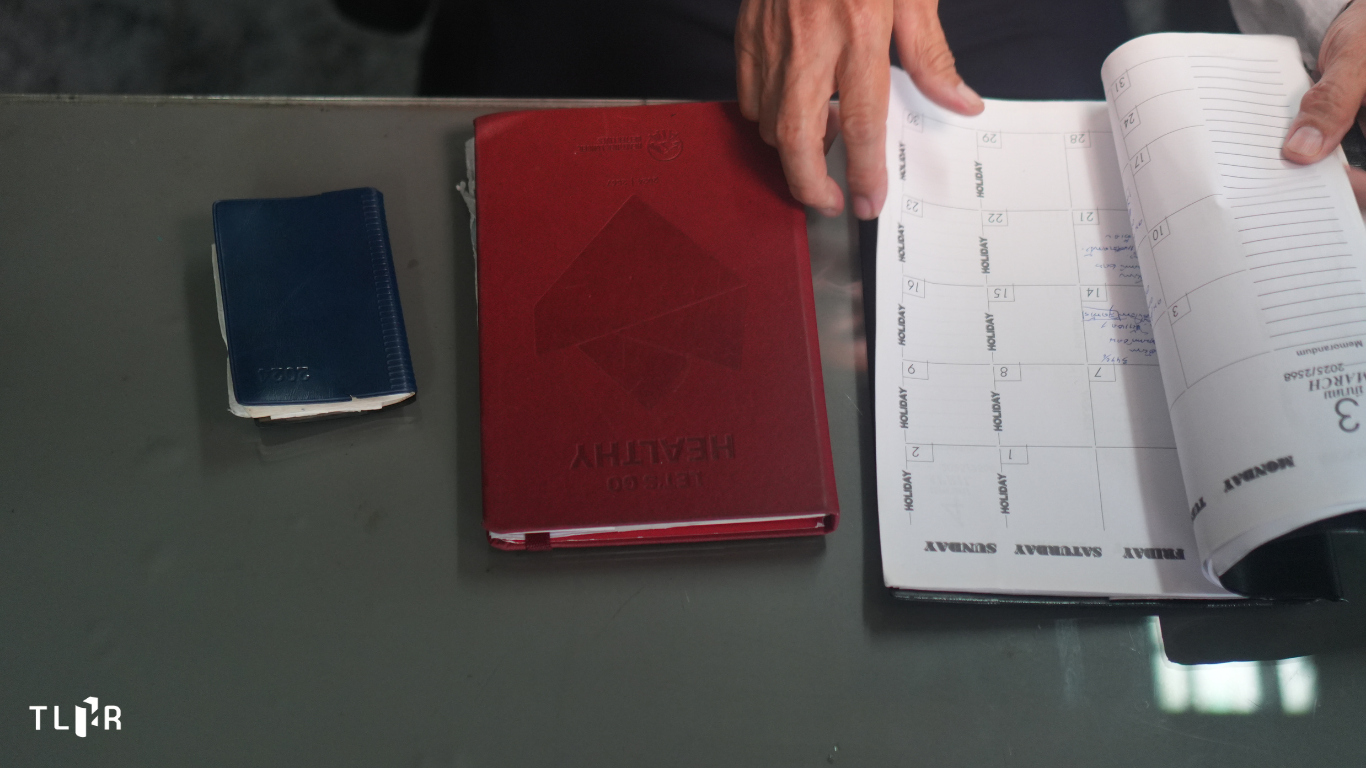
“It’s almost the new year again. I need to prepare my diaries for 2025 and 2026,” Lawyer Ratsada remarked about keeping records. I asked the senior lawyer how many notebooks he used in a year, and what kinds of things he recorded in the small notebook he always carried with him.
“At least two,” Lawyer Ratsada answered. “The small notebook I carry is for writing down case numbers, the names of the plaintiff and defendant. The larger notebook is for more detailed case notes, things like what needs to be done, the number of hearings for the plaintiffs and defendants, and the court date. The court dates are important. If I scheduled something on the wrong day or double-book appointments, it is considered my fault.”
.
.
He was a disciplined note-taker. If there was any important news about the country, Lawyer Ratsada would spend the evening recording the events in his diary, as such news was often connected to the cases he handled.
“I’m currently studying the case of the black-chinned tilapia,” he revealed about the matter he was following. “I record who gave which interview, and what information they provided. If I don’t write this down, I will forget it.”
“Are you working on the black-chinned tilapia case, Lawyer Ratsada?” I asked with interest.
“I heard there’s a lawsuit filed against the BioThai Foundation,” he replied. “If I have the opportunity to help, I should do so, because this case has wide-reaching impacts. I need to search for the truth and present it to the public. This is the duty of a lawyer. We must uncover the facts, defend the accused, and examine their intentions: what was their objective in speaking out? Was it for the public good?”
Lawyer Ratsada had just returned from Narathiwat Province after the Narathiwat Provincial Court held a hearing on the Tak Bai Case. The relatives of those who passed away during the crackdown of the protest in front of Tak Bai Police Station 20 years ago had filed a lawsuit against 7 former senior government officials.. The court had issued arrest warrants for all 7 defendants, but they were never brought to justice. Eventually, the statute of limitations on the case expired on October 25.
“Twenty years have passed, and the statute of limitations has expired. But I would say the statute of limitations on this historical event has not expired. People will continue to search for the truth. The statute of limitations will remain in the memory of those affected and in the hearts of those who believe in justice, of those who believe that the victims in Tak Bai never received justice. And that will lead to questions being raised again, whether state officials used excessive force, whether there was negligence, and how things can be corrected.”
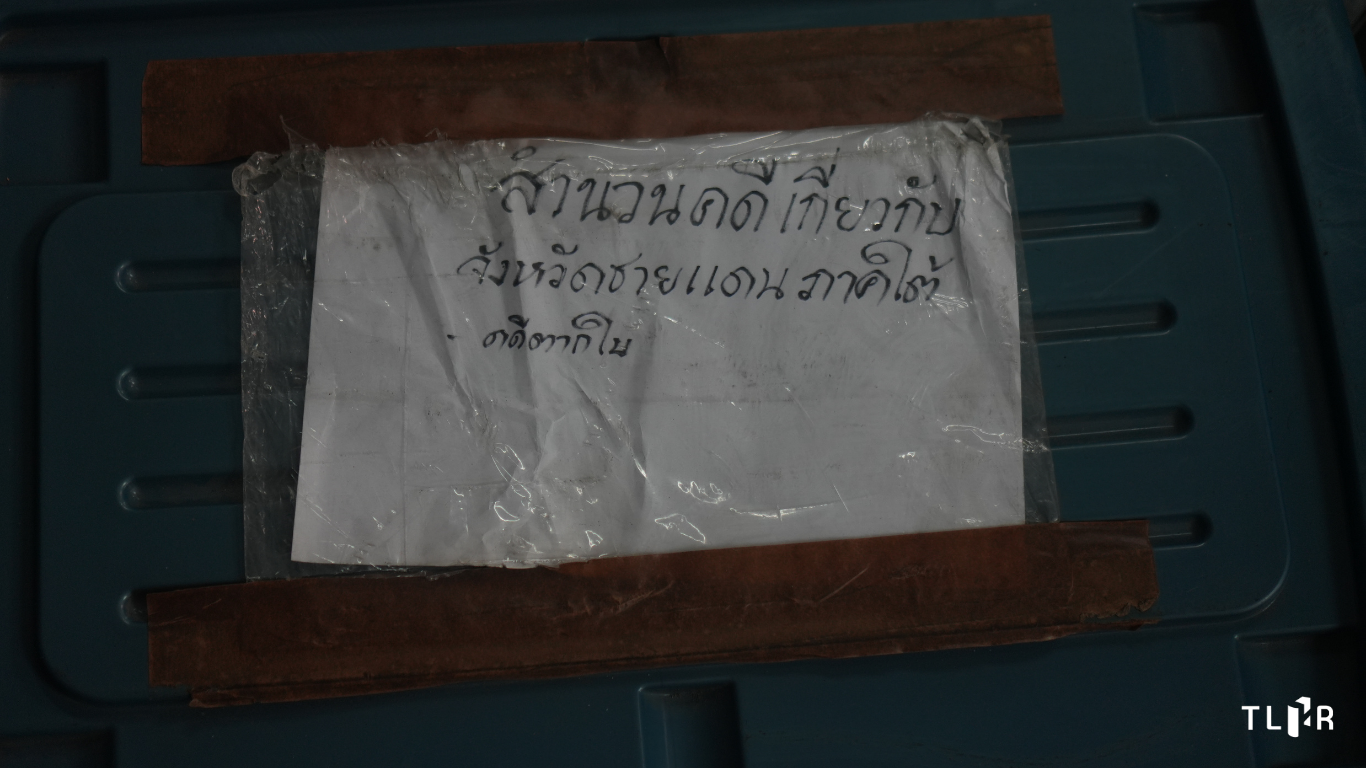
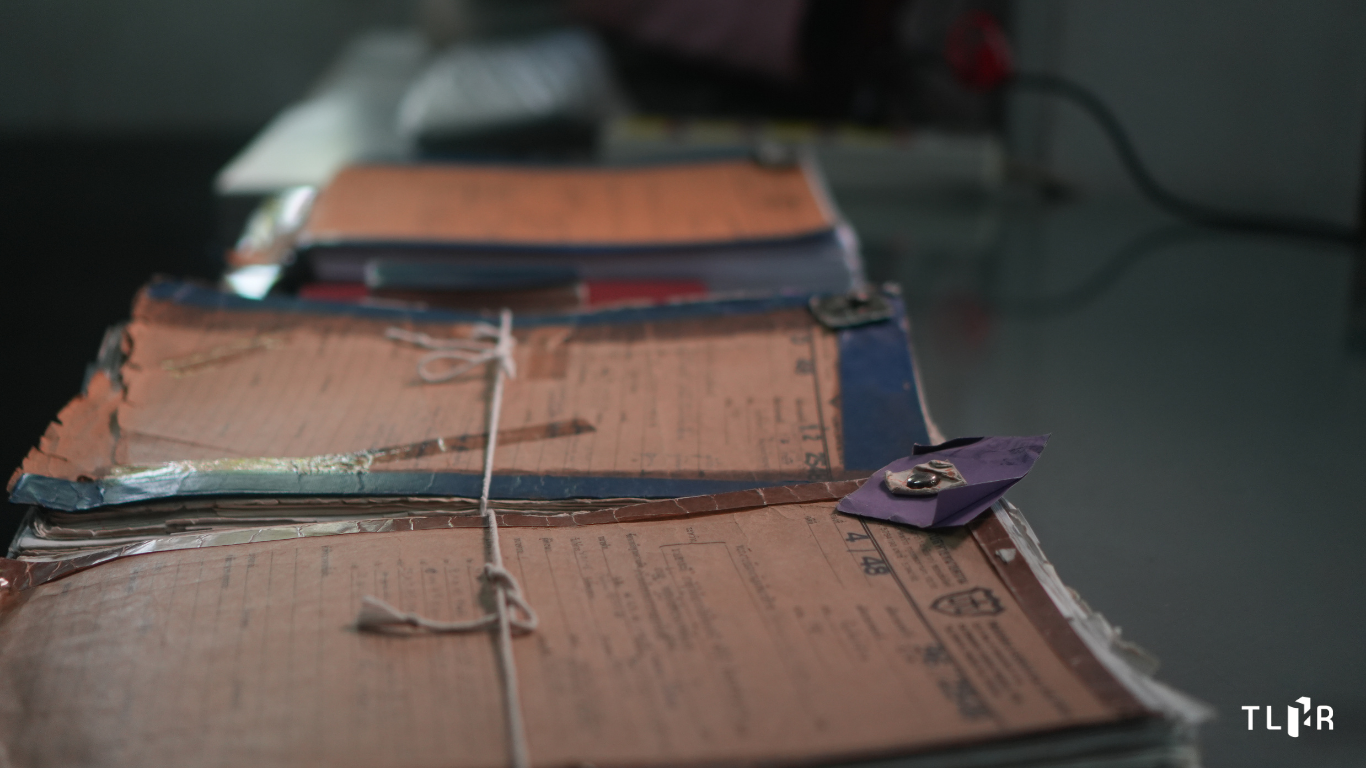
Lawyer Ratsada opened a box of case files related to the three southern border provinces for me to see. On the box was a piece of paper labeled “Tak Bai Case.” These old documents have been systematically stored since 2004.
.
.
“I’ve kept the old case documents,” he said, opening the lid to reveal neatly arranged documents. “Once everything is systematically stored, it becomes easier to retrieve. This includes documents from when I filed a civil lawsuit for compensation.”
He took out bundles of documents tied with white string, one at a time. “These are the documents from the case where 59 villagers were sued by the authorities. And these are from the inquest case.”
“The one that concluded they died from suffocation,” I added.
“Yes, from suffocation,” said Lawyer Ratsada. “Many historical events in Thai society are often forgotten. Some cases can’t even make it to court, whether because of legal limitations or because of the influence of those in power.”
The senior lawyer praised the 48 individuals who bravely stood up to file a lawsuit against high-ranking state officials in the Tak Bai case. People in the three southern border provinces have been living under special laws, and over the past 20 years there have been severe human rights violations in the region due to the enforcement of these special laws.
“Therefore, I consider the 48 individuals who stood up to sue high-ranking state officials to be courageous. Their actions ensure that this story will not be erased from history,” said Lawyer Ratsada.
Since becoming a lawyer in 1985, he has handled numerous significant cases, particularly those involving the defense of community rights in resource management, whether it’s the case of villagers protesting the construction of the Bo Nok and Hin Krut power plants, or the case of the crackdown on protesters against the Thai-Malaysian gas pipeline and gas separation plant project. He has also represented people in many security-related cases where the people’s rights were violated, such as the torture of suspects in the southern border provinces, the Tak Bai and Krue Se cases, and numerous other cases following the military coup by the NCPO. Since 2020, he has also taken on cases related to freedom of expression from the youth pro-democracy movement.
.
.
Lawyer Ratsada received the Somchai Neelapaijit Award in 2012 for his outstanding work in defending human rights against violations. In 2024, he was one of five lawyers honored by the Lawyers Council with a plaque recognizing him as a lawyer dedicated to protecting human rights.
These awards serve as evidence of his dedication to serving society, in line with the principles of Pradub and Associate Attorney Office, but the true honor of a lawyer lies in the hearts of the people.
Even though the cases that Lawyer Ratsada takes on often place him in opposition to the power of the state and capital, he says, “I feel safe.The shield that protects a lawyer’s work is the people,” Lawyer Ratsada said.
Lawyer Ratsada said that volunteer lawyers do not work alone, but rather, “We work as a team, not individually. We act on behalf of organizations, whether it’s the Union for Civil Society, the Coordinating Group for Religion in Society, or the Lawyers Council. We are assigned by our organization and by the people who are suffering. That’s why I feel that the people are protecting us.”
I asked this senior lawyer what the difference is between a ‘young lawyer’ and a ‘senior lawyer’. Beyond the passing of time and age, is there anything a ‘senior lawyer’ would like to say to the ‘young lawyer’?
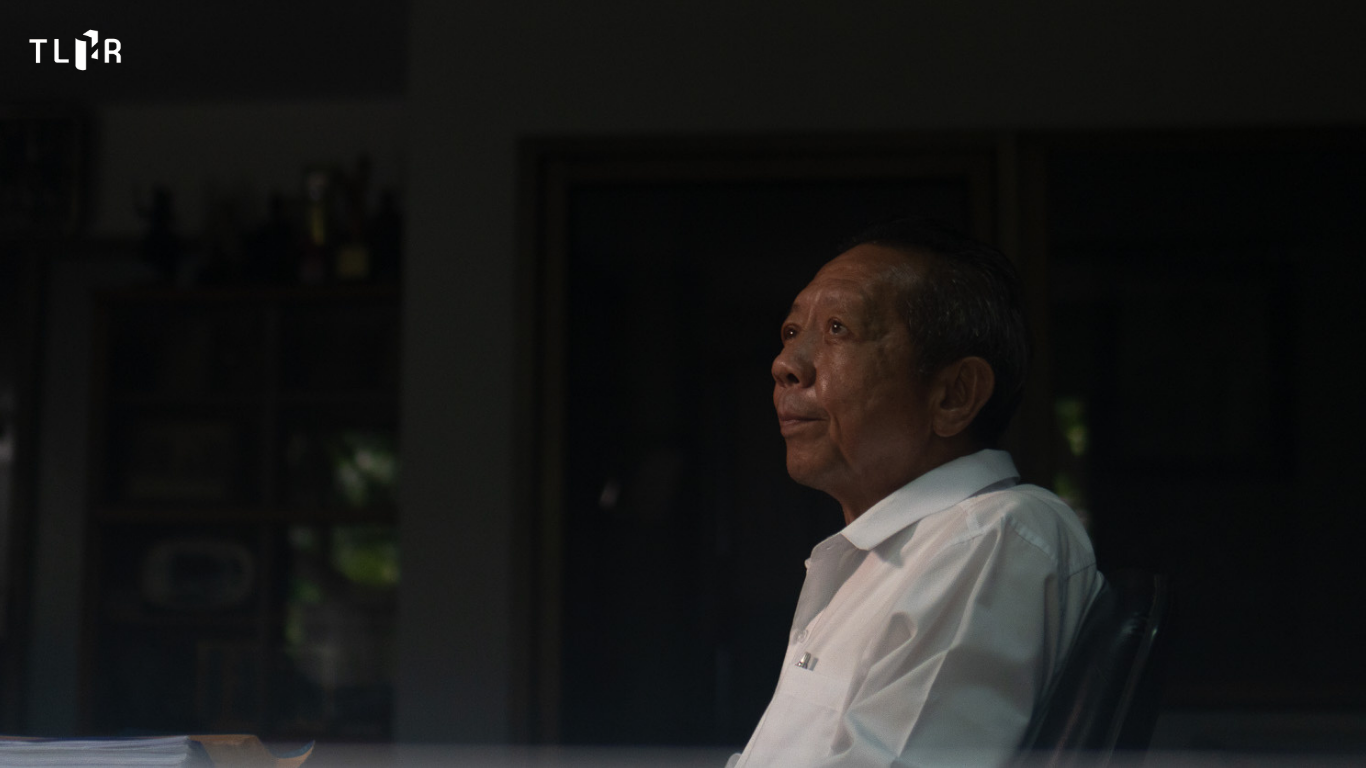
The senior lawyer chose to reflect on his own youth through the lens of the younger lawyers he had worked with, saying that the new generation of lawyers tends to be more passionate than those who have grown older. Young lawyers make effective use of technology to improve their efficiency. “They are quick in researching information to build their defenses. They present visual materials from various media very well.”
Nevertheless, fair compensation in the profession is important for young lawyers, as every life must provide for and support many others.
“Economic matters are important too. How can we ensure that they practice law while also being able to contribute to society? How can we make sure that volunteer lawyers receive fair and reasonable compensation enough to live on, to have children, to carry on their family line, and to provide security for their families? Don’t just assume that young lawyers are driven purely by a spirit of volunteerism; we must think of a compensation system that allows them to carry on their work.”
.
.
I asked Lawyer Ratsada whether he had ever encountered any economic difficulties during his time as a volunteer lawyer.
“Since my father’s law office (Pradub and Associate Attorney Office) also handles general cases, I take on general economic cases as well as volunteer cases. I give equal importance to every case, whether it is a civil case or a business case. As a lawyer, you must be responsible, never abandon a case, and always do your best.”
Lawyer Ratsada said that handling business cases helps sustain his living, but the professional compensations from business cases are shared to support cases for the disadvantaged.
“Because poor people cannot afford to hire a lawyer, the money from clients in business cases helps support them. I explain this to my business clients, and they appreciate it. They recognize the importance of access to justice and place their trust in me. That’s what allows me to keep going without hardship.”
At the same time, the organizations that provide legal assistance to the public, as mentioned by Lawyer Ratsada, each have their own rules and regulations. “No matter the organization, their purpose is to help people in accordance with the law. These organizations cover expenses for lawyers, such as travel costs, and daily allowances. These allow me to sustain the livelihood, and although it’s not much, it enables me to do something truly worthwhile.”
The end of his sentence became the starting point for a new question. I asked him, “What is the value you find in this work?”
Lawyer Ratsada answered this question by giving an example of a case in which local villagers sued Padaeng Industrial Public Company Limited over its zinc mining operations, which led to a cadmium contamination in the Mae Tao River Basin in Mae Sot District, Tak Province, affecting rice farming areas, livelihoods, and the health of the people.
But the legal battle dragged on for over 20 years, long enough to embody the saying, ‘Justice delayed is justice denied’. Eventually, in 2024, the court finally ruled that the company must compensate the affected people. Government officials were required to review operational regulations, wastewater treatment systems, and the geographical siting of the factories in relation to the community impacts.
“When you ask whether all of these things are worth it, the work I do to help the people – it’s worth the time and it’s worth it for the outcome that the people receive. That alone makes it worthwhile,” Lawyer Ratsada replied.
Nowadays, Lawyer Ratsada still has many cases under his belt, several of which involve freedom of expression issues that have been left hanging from the era of the NCPO’s rule.
“These cases are important because we must defend and support them, as their demands aim to build a fully democratic country. As long as the nation continues to experience coups, the overthrow of the constitution, and the issuing of unlawful orders, the country will continue to suffer.”
Lawyer Ratsada said that people with political opinions are not criminals, because political beliefs are something that society can disagree on. What matters is how we coexist within these differences.
“That’s why I believe these cases are important,” Lawyer Ratsada affirmed. “Even though I’m older now, I still do it.”
.
.
From interviewing other lawyers in this book, I had come to understand the number of cases involving freedom of expression that the Thai Lawyers for Human Rights has assisted, as some lawyers described it as a ‘storm of cases’, while others compared it to a ‘tsunami’. So I asked Lawyer Ratsada whether these kinds of cases, which demand so much time and energy, were an obstacle for him.
He replied, “I work with young lawyers. Working as a team allows us to exchange experiences. The young lawyers can support me in many ways, especially with research, while I have experience in the courtroom to share with them. If I can still do it, I would like to keep doing this work, though I might take on fewer cases that require long-distance travel.”
In his younger days, Lawyer Ratsada spent his life traveling across the country to argue cases, sometimes spending nearly half a month on the road. After finishing in court, it was a wonderful time for the lawyer to stroll around and take in the places he had visited.
“I’ve been to every province, but I’ve never been to the Betong Court to argue a case, only visited to see,” he laughed, as if travel itself were the special ticket granted by his work. “And there’s also Thoeng Court that I’ve never had the chance to argue at. Other than that, I’ve been to every court.”
I asked the senior lawyer to leave a message for the younger generation of law students who are about to pursue this path.
“Human rights principles are universal; they are fundamental principles. Therefore, cases involving these issues will help society coexist with respect for rights, respect for religious differences, respect for skin color, race, and ethnicity. If you understand these principles, you will see that we are all brothers and sisters,” Lawyer Ratsada spoke with confidence.
When the hour hand pointed to twelve, the sound of a pendulum clock on the wooden wall echoed clearly, exactly on time, as Lawyer Ratsada had warned his visitor.
“The function of a clock is to remind us of the time,” Lawyer Ratsada looked at the clock on the wall. “It helps me be aware of how much time I have left to complete my tasks. That’s the importance of a clock, it’s not about the price. You don’t need a watch that is worth millions.”
In another hour, the clock would chime again, reminding the senior lawyer of how much time he had left in the work of his life.
.
ข่าวหรือบทความที่เกี่ยวข้อง
Yaowalak Anuphan: Human rights work is a never-ending task
Story and Photos Veerapong Soontornchattrawat . Note: This interview series is part of the book “Feathers on the Scales”, which features ten interviews that explore the lives and experiences of human rights lawyers advocating for civil and political rights in Thailand. The book was published by Thai Lawyers for Human Rights (TLHR) in February 2025 […]

admin010
25/09/2568
Thaworn Piyawongrungruang: “Political Cases: at the very least the work of lawyers lessens the hardship of the activists.”
Story by Noppon Archamas . Note: This interview series is part of the book “Feathers on the Scales”, which features ten interviews that explore the lives and experiences of human rights lawyers advocating for civil and political rights in Thailand. The book was published by Thai Lawyers for Human Rights (TLHR) in February 2025 and was later […]
admin010
03/10/2568
Krisadang Nutcharus: Life of a Human Rights Lawyer ‘Standing Firm, Never Surrendering’
Story by Weerawat Somnuek . Note: This interview series is part of the book “Feathers on the Scales”, which features ten interviews that explore the lives and experiences of human rights lawyers advocating for civil and political rights in Thailand. The book was published by Thai Lawyers for Human Rights (TLHR) in February 2025 and was later […]
admin010
09/10/2568
Muay Junjira – The Fighting Lawyer: When the Court Lacks Justice, We Have the Right to Challenge It.
Story By Wanna Tamthong . Note: This interview series is part of the book “Feathers on the Scales”, which features ten interviews that explore the lives and experiences of human rights lawyers advocating for civil and political rights in Thailand. The book was published by Thai Lawyers for Human Rights (TLHR) in February 2025 and was later […]