
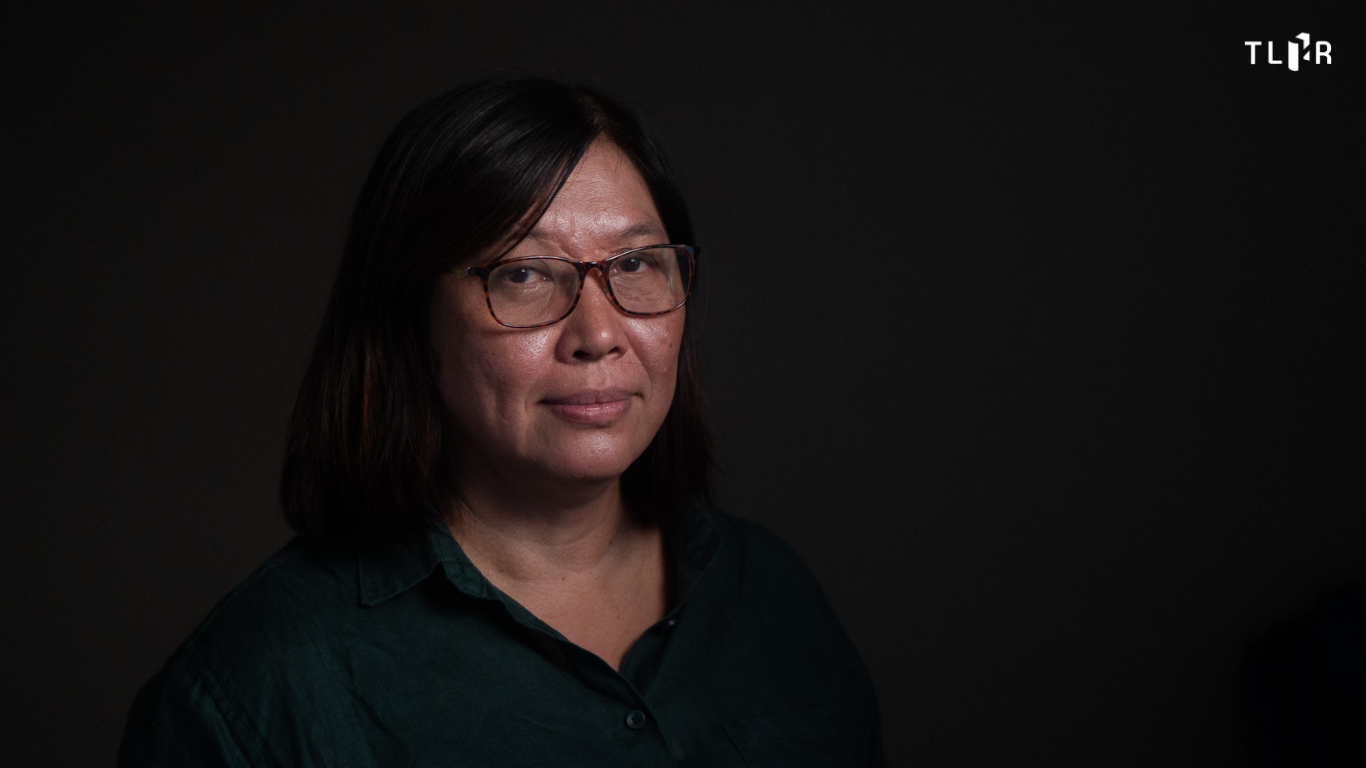
Story and Photos Veerapong Soontornchattrawat
.
Note: This interview series is part of the book “Feathers on the Scales”, which features ten interviews that explore the lives and experiences of human rights lawyers advocating for civil and political rights in Thailand. The book was published by Thai Lawyers for Human Rights (TLHR) in February 2025 and was later translated into English.
——————————
.
“Human rights work is a never-ending task. Even when a case is closed, our work goes on.”
Two days after the coup, a group of lawyers came together to assist those who had been arrested for protesting against the National Council for Peace and Order (NCPO)’s seizure of power. One of the first missions of the junta was to summon individuals with critical views to report themselves, a process that led to violations of rights and freedoms. The junta also arrested protesters who demonstrated in public spaces. At that time, representing the protestors was to be a temporary mission for the group of lawyers who came to be known as Thai Lawyers for Human Rights; little did anyone know that the organization’s work would continue to this day.
Lessons from the 1991 coup led Yaowalak Anuphan to expect that the NCPO would stay in power for a short while before handing power back to the people to hold an election. At the time, she told the younger volunteer lawyers that they would be doing this work just for 6 months. But, she said today with a tired smile, “We’ve been doing this for 10 years now.”
Six months passed from the day the coup took place, but it seemed as if the work of the volunteer lawyers had only just begun. Managing the organization became necessary, including through assigning roles and securing salaries for the team. One by one, the lawyers gradually resigned from their regular jobs to work full-time for Thai Lawyers for Human Rights. From originally having no more than seven staff members, today Thai Lawyers for Human Rights (TLHR) has 40 full-time staff,30 volunteer lawyers nationwide, and many paralegals.
“It’s unbelievable that we’ve grown into an organization this big,” Yaowalak said sarcastically.
The growing role of TLHR stands in stark contrast to the declining human rights situation. Those who cherish justice and value freedom hope to one day see a TLHR farewell party: the completion of TLHR’s mission would signify that Thai society has finally entered a state of stability, like any civilized society.
“Human rights work is a never-ending task,” Yaowalak said. “Even when a case is closed, our work goes on.”
The goal of TLHR is to advocate for policies aimed at reforming the justice system. To achieve this goal, the role of TLHR includes providing legal assistance, documenting human rights violations in Thailand, and disseminating knowledge on both the law and justice system reform in accordance with international legal principles.
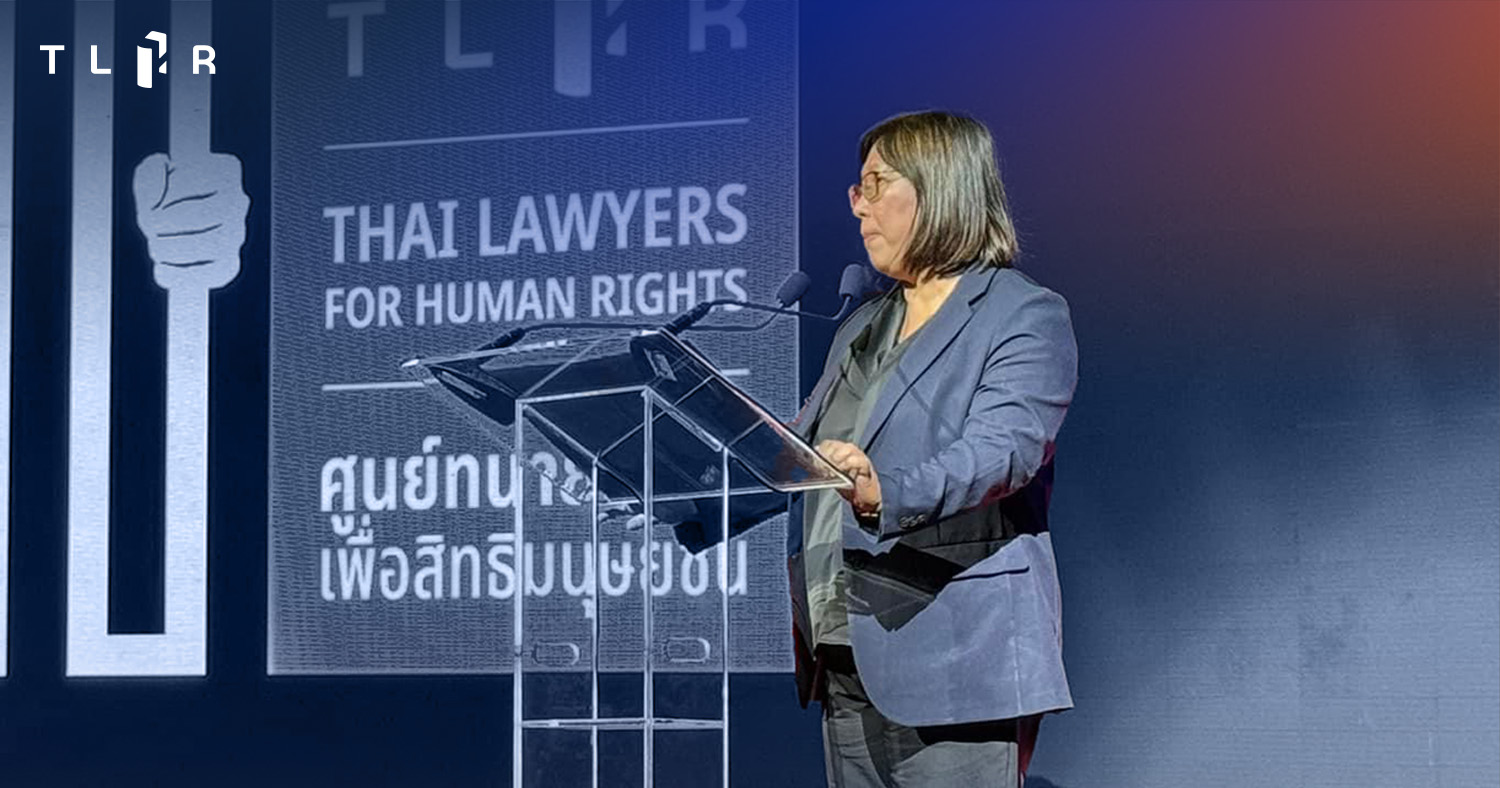
“We have a wealth of information and believe that it can lead to change.” As the director of TLHR, Yaowalak envisions TLHR as an intellectual institution for democracy, the rule of law, the legal state, human rights, and even a legal archive.
.
.
“I believe we are the organization that handles the most cases under Sections 112 and 116, which are particularly interesting. If you ask why there has been such a rise in these cases over the past three to four years, the answer might lie in the timing of history,” Yaowalak said.
By this, Yaowalak is referring to various events that led to the rise of political prosecution.. For example, the generational attitudinal shifts within society have played a significant role. The atmosphere of Thai society in the five years following the coup was noticeably different from the first five years. I [the interviewer] can still remember the fear that gripped Thai society, as well as my own personal fear.
The NCPO used laws to suppress the people, bring civilians before military courts, and commit various acts of threats and intimidation. The phone number of TLHR that was saved in my SIM card stands as clear evidence of this. After the dissolution of the Future Forward Party, what followed was no longer the same.
Illegitimate power couldn’t subdue defiant people, including the lawyers who provided assistance to them. The work of the lawyers reaffirmed to the defendants that they had the right to freedom of expression, even though the people’s rights and freedoms had been stunted, like a bonsai tree confined in a beautiful pot.
“People who faced prosecution often expressed their gratitude to TLHR. The presence of the TLHR gave them the courage to come forward and speak out. However, at this moment, everything seems to have come to a standstill, with protest leaders being prosecuted. After 2020, people have been wounded emotionally and mentally. But if something were to happen, I believe they would be ready to rise again,” Yaowalak said with confidence.
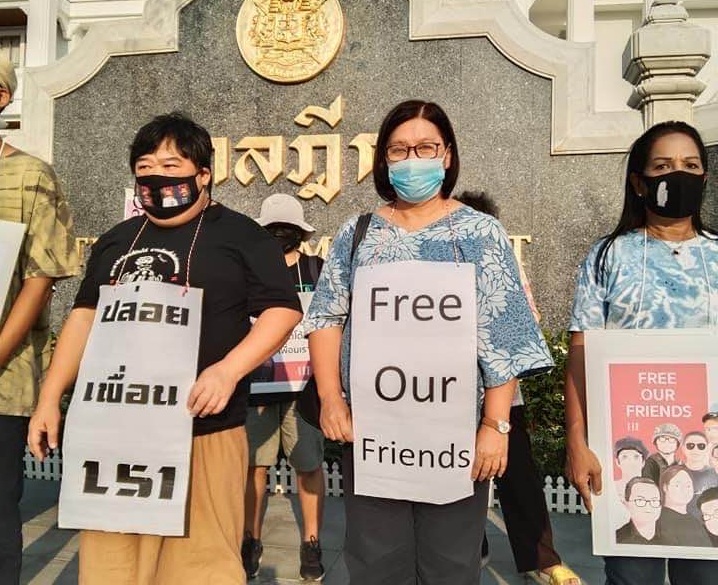
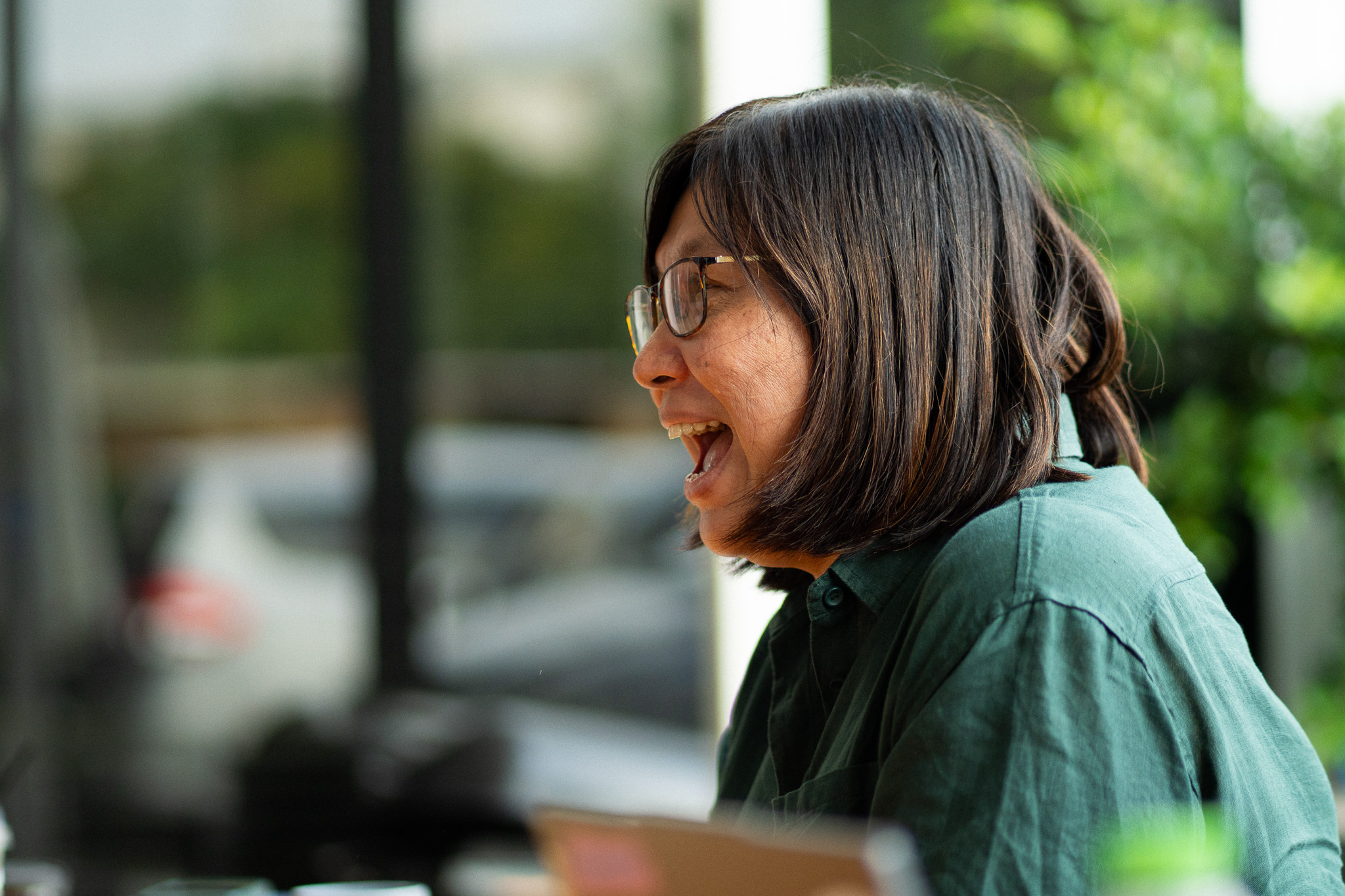
The face of Arnon Nampa is drawn on a blackboard inside the TLHR office. His photographs are placed on some lawyers’ desks, turning the TLHR office that might otherwise feel serious and formal into one filled with emotion and sentiment.
“I’ve never felt this exhausted from legal work before,” Yaowalak said. “Back when I handled corporate cases, I pleaded cases in court every day, morning and afternoon, to the point that I’d fall asleep on the bus. But after I began working on TLHR cases after 2020, I don’t even know how to describe it. It was a storm of cases.”
Her response prompts reflection on how a lawyer manages to survive the storm of cases.
“Honestly, I shouldn’t be pleading cases anymore. I should be stepping back to oversee the bigger picture. But there are so few lawyers handling Section 112 cases, so I have to take them on too. I’ve spent months sleeping at the office,” Yaowalak said.
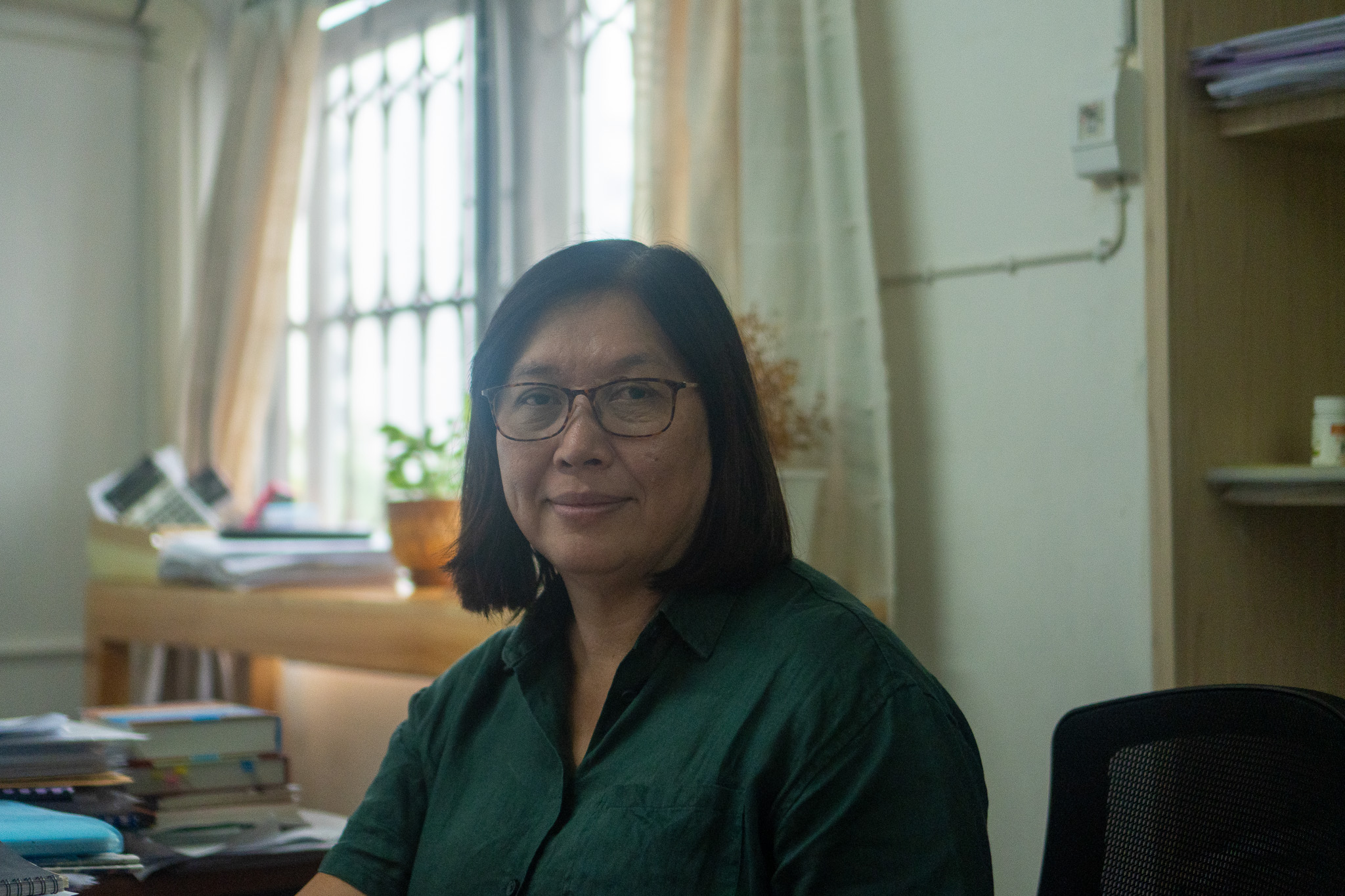
Stacks of case files are piled high on Yaowalak’s desk. Her current task is to go through the documents once handled by a previous lawyer who is now an inmate, detained without the right to bail and unable to fight the case from the outside.
“I told the younger lawyers that I can’t take on any new cases right now. I have to write the appeal against the verdict on behalf of Arnon. Since he’s in prison, he can’t do it himself. So I had to step in as the replacement lawyer, and now I’m back to going through the case documents to write the appeal. There are so many. I’m still just sitting here, staring at them,” Yaowalak sighed.
.
.
The backlog of cases that raged like a storm, as Yaowalak described, made it necessary to bring in more staff. New generations took turns stepping in to meet the increasing workload of the office. The coexistence between different generations became one of the key challenges of working in this era.
Yaowalak described the people who worked at TLHR during its first five years as a group driven by passion, who volunteered to step in and oppose the coup. However, after 2020, with the rise of the youth-led movement, rights became a core value of the new generation. The new generation of lawyers and staff who joined since then are like a fresh melody woven into the structure of the original song.
“The younger generation believes in work-life balance, but the first generation had no balance at all,” she said with a smile, referring to the pioneering lawyers. “We worked day and night, so much that TLHR had to introduce rules saying you had to take breaks and vacations. But the new generation came with a work-life balance mindset, a strong sense of personal boundaries, which is something I’ve had to learn.”
Generation X lawyers have to learn the new generation’s work rules; for example, talking about work on weekends is considered inappropriate.
“Exactly,” Yaowalak agreed. “No emails allowed on the weekend, it’s like that now. I’ve had to learn a lot from working with Gen Z. We can’t manage things the same way we did during the first five years anymore.”
The rhythm of life is like the soft footsteps of an individual, blending with the small steps of others, until they form a collective rhythm of society’s movement, harmonizing into the rhythm of history. When Yaowalak was a child, women were expected to be nurses or teachers, while men were expected to be police officers or soldiers.
“In our time, very few women became lawyers or even studied law,” Yaowalak said. “Being a female lawyer in the past meant pushing through stereotypes and biases to be accepted. But today, much of that has been broken down. Women are now present throughout the justice system, as police officers, prosecutors, and judges. Even though gender bias still exists, much has been overcome.”
Yaowalak grew up in a Buddhist family within a Muslim community in Su-ngai Kolok District, Narathiwat Province, where her childhood was shaped by the sounds of explosions and news of the armed Chinese-Malaya communist insurgents and the southern insurgents movement. Her father was a police officer, and her mother was a vendor.
“We were taught to be cautious, to know how to take care of ourselves when we heard explosions,” she said.
One extracurricular book played a significant role in shaping her childhood identity. “At that time, I wanted to be a development worker like the heroine in the novel Pulakong,” Yaowalak said, before revealing that the very same book shattered her identity years later when she read it again.
The book was Pulakong by Sopak Suwan. After the Tak Bai incident in 2004, she realized that the Pulakong of the novel and the hometown she actually lived in were not the same home.
“The books we read as children hardly told the truth about what really happened in our home,” Yaowalak said.
The heroine in the novel was a Buddhist development worker who entered a Muslim community (much like Yaowalak herself). The story raised the question of why Muslim children didn’t sing the Thai national anthem (which resonated with her own experience, as her Muslim friends didn’t sing the Thai national anthem either, and she wondered why).
“We grew up just the way the state wanted us to,” Yaowalak said, reflecting on a girl in Su-ngai Kolok who grew up to become a human rights lawyer.
“But in the end, I thought the law might hold the answers. I saw injustice in my hometown, and my eldest sister had become a judicial officer. When I visited her at the Narathiwat Provincial Court, it made me want to study law even more,” she said.
.
.
Yaowalak studied law at Ramkhamhaeng University while passionately engaging in extracurricular activities. She traveled to rural development camps in regions beyond her hometown, as if the whole world was waiting for the young girl to explore. But her hometown remained a constant backdrop she carried with her. That’s why she became interested in women’s rights work, because in the 1980s, Su-ngai Kolok faced severe economic hardship, pushing many women to the risk of being trafficked into sex work.
“When I was a student, I volunteered at the emergency shelter under the Status of Women Association in Patronage. Whenever the police raided brothels, young girls would be brought to the shelter,” she said, describing the beginning of her journey to learn about human rights work.
From Su-ngai Kolok to Chiang Mai, in the final year of her university life, Yaowalak began working as a project officer for a women’s leadership training program in Northern Thailand at the Women’s Studies Center, Chiang Mai University. It was there that she discovered the potential of women. She had grown up with the idea that women had to rely economically on men and had little voice or agency. But here, “I found that women leaders in the nine northern provinces played leading roles. Because, at that time, women in Thai society still faced discrimination, and restrictions on pursuing certain professions. There were no female police officers, and even fewer female lawyers,” she said.
During her ten months in Chiang Mai, the news from Bangkok drew her in. It was the news of a coup in the month of love.
“I remember when the National Peace Keeping Council (NPKC) staged a coup in February 1991, I was living in Chiang Mai at that time. My friends were doing activities to oppose the coup, and I just felt like Chiang Mai wasn’t the place for me anymore. I had to go to Bangkok,” she said with a smile, unsure if it was the same smile that would later meet the two more coups in 2006 and 2014.
After receiving her lawyer’s license in 1993, Yaowalak began working in corporate cases at a law firm, only to realize that “it just wasn’t me. I was an activist, I was drawn to social work. But once I started working in corporate cases, I knew that it wasn’t me,” she said.
That space exposed her to the true face of the justice system, as she had to deliver documents to a client negotiating with a judge, a prosecutor and a police officer, to the melody of karaoke songs playing in the background. In that room were women she had once helped as a law student, women who were now serving and entertaining the men as they were making certain deals outside the courtroom.
.
.
“I remember there were sex workers sitting in that room, and since I had worked on women’s issues before, I thought, ‘Is this what society is really like?’ I didn’t say a word, just handed over the documents and went back to the office. I’m a lawyer trying to make justice straightforward, but the real world isn’t as straightforward as I thought,” Yaowalak said.
She described working at the law firm for a year as her ‘make-money’ phase, to build a foundation to support herself and her family and gain enough legal experience to begin walking on the path she truly wanted– one far less smooth than the path of handling corporate cases.
The human rights situation became a significant focus after the 1997 Constitution, with the Lawyers Council establishing a Human Rights Commission to assist the public with human rights issues. Yaowalak provided legal assistance to women but also began taking on cases in other human rights areas, such as land and forest issues or stateless individuals. She then pursued a public law certificate at Thammasat University, where encountering professors like Worachet Pakeerut, Worapot Wisarutpit, and others became a crucial influence in shaping her legal career.
“Professors taught us that a lawyer who supports a coup is like a monk who has broken their precepts. If you’re a political scientist supporting a coup, the professors wouldn’t blame you, because it’s about theories of governance. But if you’re a lawyer, you live by the law, and then you tear it apart – that’s not right.”
But the law was torn apart once again in September 2006. After the coup, Yaowalak went to intern at the Asian Human Rights Commission (AHRC).
“That was another turning point for me,” Yaowalak recalled of her short time in Hong Kong that nevertheless took deep root in her identity. “If we don’t have principles, we end up supporting authoritarianism and destroying the principles of democracy ourselves. If we hold firmly to principles, we will not support any extralegal means.”
When speaking of the crucibles that shaped her life, Yaowalak pointed to three: 1. Ramkhamhaeng University, 2. Studying for the Public Law Certification at Thammasat University, and 3. Her internship at the AHRC.
After returning from Hong Kong, between 2009 and 2011, Yaowalak worked as a legal consultant at the Cross Cultural Foundation and the American Bar Association (ABA). It was during this time that she began to look back at her hometown through the lens of human rights violations in the three southern border provinces. She was no longer the heroine from the novel Pulakong.
.
.
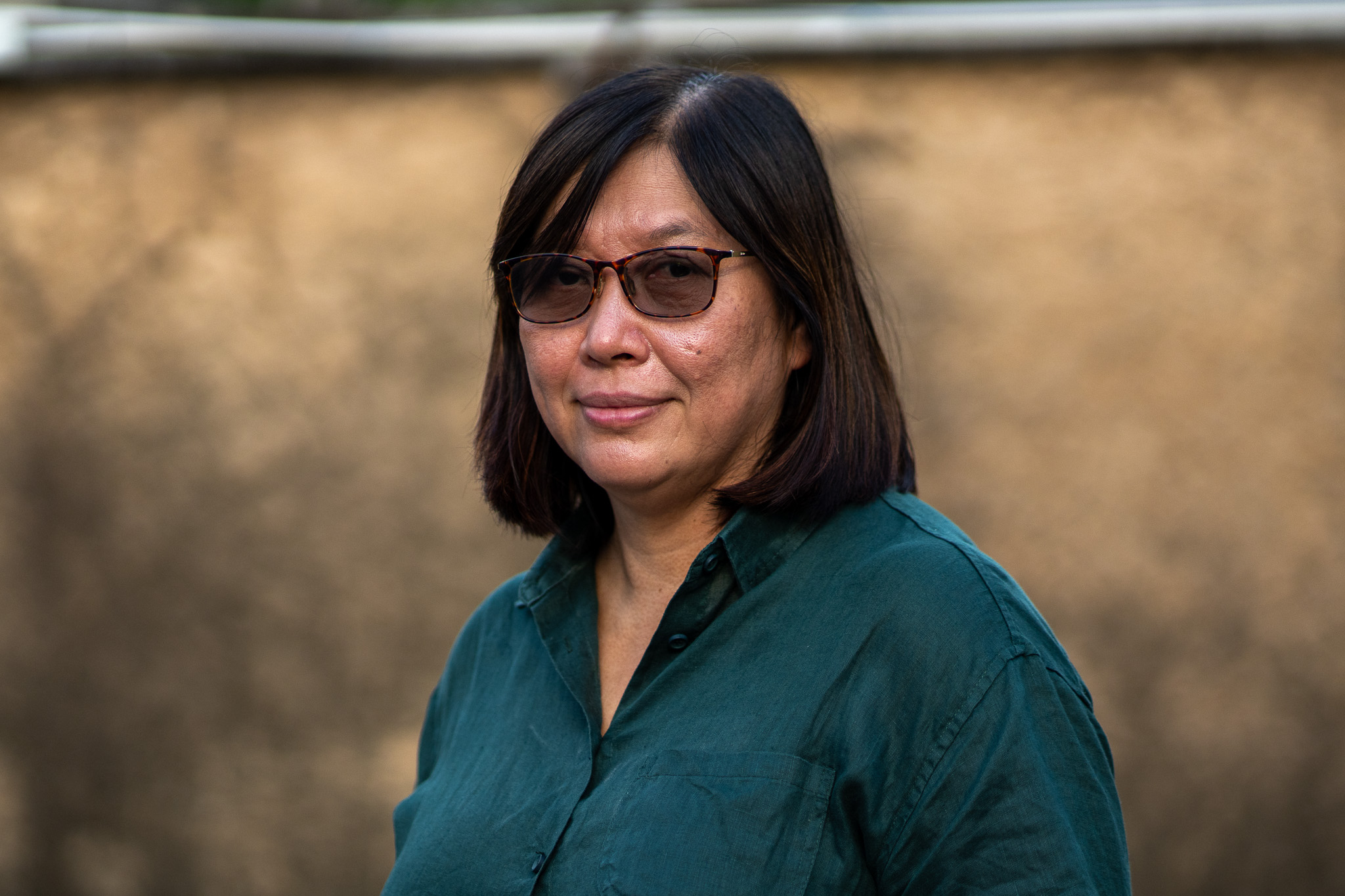
It was during this time that she came to know many younger lawyers, including Arnon Nampa, Sirikan Charoensiri, Pawinee Chumsri, Poonsuk Poonsukcharoen, and other human rights lawyers. In just a few years, they would come together to assist people arrested by the NCPO after the 2014 coup. And over the next decade, nothing would ever be the same again, both in this office and in Thai society.
“Being a lawyer is a profession that destroys dreams, imagination, and the beauty of life,” Yaowalak joked. “Ever since I became a lawyer, I’ve hardly read any literature at all.”
The texts she had to read were Supreme Court verdicts, legal statutes, and case files to prepare for the cases she handled. “So, when would I ever have time to sit and read literature? I ended up watching TV series instead, Chinese dramas, Korean dramas, just to see some good-looking actors, handsome leading men,” the woman lawyer smiled.
“When I was a student, I read the Pirap Daeng (The Red Dove by Suwat Woradilok), Pirap Moen (The Dove Turns Away by Suwat Woradilok), With Love of Ideals (by Wat Wanlayangkoon), One Hundred Years of Solitude (by Gabriel García Márquez). Looking back, they are such good memories.”
Memories are like stars. We still see their light in the sky, and even though the stars themselves may have already faded away, their light still shines.
And perhaps that is Yaowalak’s own star. Yet the place where she stands observing it is a space filled with the stories of many people, stories that continue to unfold.
.
ข่าวหรือบทความที่เกี่ยวข้อง

Public Statement Condemning Bomb Attacks in Southern Thailand, Demanding Fair Trial Rights and Transparent Investigation
Public Statement Condemning Bomb Attacks in Southern Thailand, Demanding Fair Trial Rights and Transparent Investigation During 11-14 August 2016, 17 explosions took place in seven provinces in Southern Thailand causing a number of lives and damages. Since 13 August 2016, the Thai authorities have responded by invoking Section 44 of the Constitution of the […]

TLHR
15/08/2559
TLHR report four years on from coup: Thai society “wrecked” by NCPO
22 June 2018 — Thai society has been “wrecked” by the National Council for Peace and Order, Thai Lawyers for Human Rights (TLHR) has said in its newly released report on four years of military rule in Thailand. The report, which was launched on Friday at the Foreign Correspondents’ Club of Thailand, warns of the […]
TLHR
22/06/2561
You Can “Run Against Dictatorship”: Basic Legal Recommendations before Staging a “Run Against Dictatorship” Event
On 12 January 2020, people in several Thai provinces and abroad will unite to “Run Against Dictatorship”. Thai Lawyers for Human Rights has found that event organizers in Bangkok and other provinces have faced difficulty in obtaining permission to use some locations for the event, being threatened by officials when requesting permission to stage the […]

admin010
10/01/2563
Summary of “The Legal Opinion on the Declaration of the State of Emergency in Response to COVID-19 Pandemic”
By virtue of the Emergency Decree on Public Administration in the State of Emergency B.E. 2548 (2005) (“The Emergency Decree”), the Prime Minister announced the government would declare a state of emergency in all areas in the Kingdom in response to COVID-19 pandemic. The state of emergency is in effect from 26 March to 30 […]