

Dr. Paul Chambers, an American academic whose research specializes in civil-military relations in Southeast Asia, was detained on lèse majesté charges and the Computer Crimes Act by Thai authorities in April 2025. The charges stemmed from allegations that Dr. Chambers posted a blurb for a webinar—hosted by Singapore’s ISEAS–Yusof Ishak Institute, where he was a speaker—on the Institute’s website, and that the text contained defamatory language about the Thai monarchy.
On the day of his arrest, Dr. Chambers was denied bail and detained in Phisannulok Provincial Prison. Although bail was later granted, it is notable that the bail conditions imposed strict restrictions on his freedom. The bail imposed was 600,000 THB (approx. 18,000 USD). He was required to wear an electronic monitoring device around his ankle at all times, and was prohibited from leaving Thailand without court approval. In addition, his passport was confiscated, and he was appointed a court-approved supervisor. The circumstances leading to his arrest and pre-trial detention call into question the legality of his detention, and highlight the persisting concern regarding the violation of pre-trial rights in Thai courts.
This article seeks to examine the legality of Dr. Chambers’ detention and the subsequent actions of the court under both Thai domestic law and international human rights law. We urge readers to critically engage with the troubling implications of this case and to reflect on the broader issue of arbitrary detention as a threat to fundamental freedoms and the rule of law.
The Pre-Trial Detention of Dr. Chambers Violated Thai Domestic Law
The Constitution of the Kingdom of Thailand (hereafter “Constitution”) guarantees the fundamental rights and freedoms of all individuals, including foreign nationals residing in Thailand. One fundamental principle, enshrined in Section 29, paragraph 2, of the Constitution, is the presumption of innocence. This principle guarantees that a suspect is presumed to be innocent until proven guilty through a lawful judicial process. It ensures that the accused is not subjected to the same treatment as those who have been convicted.
The right to bail is a core legal tenet that underpins the presumption of innocence. This constitutionally enshrined right safeguards both the liberty of the accused and ensures their ability to mount an adequate legal defense. Section 108/1, Paragraph 1, of the Criminal Procedure Code provides that denial of bail may only occur if there are reasonable grounds to believe one of the following:
- The accused or defendant will escape;
- The accused or defendant will get involved in the evidence;
- The accused or defendant will cause other dangers;
- The applicant for bail or the security is not credible;
- The provisional release will obstruct or cause damage to the proceedings of inquiry of a competent official or the proceedings in the court.
In line with the principle of the presumption of innocence, Section 29, paragraph 3, of the Constitution further provides that:
“Custody or detention of a suspect or a defendant shall only be undertaken as necessary to prevent such person from escaping. “
Detention of the accused should thus not be imposed as a routine measure but must be deemed necessary based on the circumstances of the case, which the courts must strictly scrutinize. The State is therefore obligated to avoid unnecessary pre-trial detention.
Additionally, Section 86 of the Criminal Procedure Code mandates that restraints on an arrestee must not exceed what is necessary to prevent escape. Section 87, paragraph 1, further states that an arrestee must not be detained longer than is necessary based on the circumstances of the case.
It is thus clear that Thai law permits restricting the liberty of an accused only when strictly necessary—such as to prevent escape—and only after careful consideration of the specific facts of each case.
In this case, the Phitsanulok Provincial Court issued an order permitting Dr. Chambers’ detention during the pre-trial investigative stage. After the detention order was issued, Dr. Chambers was denied bail twice, with the court citing as reason:
“[1] The offense carries a high penalty, [2] the accused is a foreign national, and [3] the complainant [inquiry official] objected to the bail request. Therefore, the request is denied.”
The specific grounds under Section 108/1 for the judge’s order remain ambiguous. It is uncertain whether the “high penalty” under Section 112 had to do with the judge’s concerns about Dr. Chambers’s potential flight (Section 108/1(1)), fear of other dangers he might pose (Section 108/1(2)), or both. Additionally, the relevance of Dr. Chambers’s foreign nationality to the bail denial was not clarified. Finally, the validity of the inquiry official’s objection as a ground for bail denial is questionable, as it is not stipulated in Section 108/1.
Notwithstanding the legal ambiguities in the bail denial, Dr. Chambers’s lawyer had clearly explained to the judge why he should be granted bail. He was a resident of Thailand who had spent more than three decades building his life in the country. He also had verifiable employment at Naresuan University. All of these factors indicated no evidence that he would flee the country. (Section 108/1(1)) Additionally, neither the police nor the judge presented evidence that he would either temper with the evidence, commit another dangerous act, or would hinder the investigation of the case. (Section 108/1(2)(3)(5)) Dr. Chambers’s pre-trial detention thus is in violation of Section 108/1 of the Criminal Procedure Code.
Furthermore, the Thai authorities’ detention of Dr. Chambers—who was merely accused of posting statements on a website over which he clearly had no control—in prison alongside convicted criminals constituted a violation of the presumption of innocence under Section 29, paragraph 2, of the Thai Constitution, as it treated him as if he had already been found guilty of a crime.
The Detention of Dr. Chambers was in Violation of International Human Rights Law
As a State Party to the International Covenant on Civil and Political Rights (hereafter “ICCPR”) and other related human rights instruments, Thailand is bound by international legal obligations to align its legislative, executive, and judicial actions with international human rights standards.
Arbitrary detention is explicitly prohibited under Article 9 of the Universal Declaration of Human Rights, which states: “No one shall be subjected to arbitrary arrest, detention or exile.” Similarly, Article 9(1) of the ICCPR provides: “Everyone has the right to liberty and security of person. No one shall be subjected to arbitrary arrest or detention. No one shall be deprived of his liberty except on such grounds and in accordance with such procedures as are established by law.”
Moreover, Article 9(3) of the ICCPR emphasizes: “It shall not be the general rule that persons awaiting trial shall be detained in custody, but release may be subject to guarantees to appear for trial, at any other stage of the judicial proceedings and, should occasion arise, for execution of the judgement.”
General Comment No. 35 by the UN Human Rights Committee elaborates that deprivation of liberty inconsistent with Article 9 of the ICCPR can include: (1) detention that is unlawful but not arbitrary, (2) detention that is lawful but arbitrary, or (3) detention that is both unlawful and arbitrary.
The concept of “arbitrariness” thus goes beyond mere illegality. Arbitrary detention must be assessed through factors such as inappropriateness, injustice, unpredictability, lack of due process, and considerations of reasonableness, necessity, and proportionality.
The UN Working Group on Arbitrary Detention (hereafter “WGAD”) considers a deprivation of liberty to be arbitrary when the facts fall under one of five categories:
(I) Detention without a legal basis;
(II) Detention as a result of exercising fundamental rights;
(III) Denial of the right to a fair trial;
(IV) Prolonged detention of asylum seekers, refugees, or migrants without judicial review;
(V) Discriminatory detention.
The Detention of Dr. Chambers was Arbitrary Due to the Lack of a Legal Basis
In General Comment No. 34, the UN Human Rights Committee explains that legal norms must be sufficiently precise to allow individuals to regulate their behavior and be publicly accessible. Laws must not provide unlimited discretion to restrict freedom of expression.
Dr. Chambers was detained under Section 112 of the Thai Criminal Code. The WGAD has issued 12 opinions since 2012 stating that Section 112 is vague and overly broad, lacking a clear legal definition of what constitutes lèse majesté. Section 112 is thus in violation of the principle of legality, which requires laws to be clear, accessible, and predictable. The WGAD also previously observed that enforcement of Section 112 is also left entirely to the discretion of authorities, rendering it incompatible with international legal standards. For these reasons, Dr. Chambers’s detention was arbitrary because it was based on a law that, under international law, could not serve as a legal basis for depriving a person of liberty.
The Detention of Dr. Chambers is Arbitrary, as His Detention is a Result of Him Exercising Fundamental Rights
Dr. Chambers’ arrest stemmed from allegations that he posted a promotional text about an academic webinar titled “Thailand’s 2024 Military and Police Reshuffles: What Do They Mean?” on the website of the Yusof Ishak Institute. Dr. Chambers denied ever posting such promotional material, stating that he did not administer the website and was not authorized to post material on it.
Even assuming, arguendo, that Dr. Chambers did post the promotional text on the website, the basis of the detention rests on the exercise of freedom of expression, a fundamental right protected under Article 19(1) of the ICCPR, and associated right to academic freedom.
Article 19(3) allows limited restrictions to the freedom of expression. However, such restrictions must be lawful, necessary, and proportionate, and must protect the rights or reputations of others, public order, national security, public health, or morals.
General Comment No. 34 further affirms that public figures, including heads of state—of which the Thai King is one—are subject to legitimate public criticism, and that harsh penalties should not be imposed solely based on the identity of the individual being criticized. Here, invoking lèse majesté on grounds that Dr. Chambers’ alleged text undermined royal authority is in direct contradiction to Article 19(1) and (3) of the ICCPR.
The Detention of Dr. Chambers was Arbitrary Because He was Denied the Right to a Fair Trial
Article 14(2) of the ICCPR provides that “Everyone charged with a criminal offence shall have the right to be presumed innocent until proved guilty according to law.” This principle—the presumption of innocence—is central to the right to a fair trial and applies at every stage of the criminal justice process, including charging, detention, trial, and conviction.
Another core principle of the right to a fair trial is enshrined in Article 9(3) of the ICCPR, which states that detention of individuals awaiting trial shall not be the general rule. Rather, the presumption should be in favor of release, with pretrial detention used only as an exception.
In this context, the WGAD, commenting on the case of Anchan, emphasized that pre-trial detention must remain an exceptional measure. Any decision to detain must be based on individualized assessments grounded in necessity—such as risk of flight, tampering with evidence, or risk of reoffending— and proportionality. The grounds for detention must be clearly defined in law and must not rely on vague or overly broad concepts such as “public safety.” The WGAD further noted that courts should not rely solely on the severity of penalties under Section 112 as a reason to deny bail, regardless of the accused’s specific circumstances.
Accordingly, any measure that undermines the presumption of innocence—such as the denial of bail without reasonable justification or the imposition of unduly harsh bail conditions—may constitute a violation of this fundamental right.
Here, after Dr. Chambers reported to the Phitsanulok Provincial Police Station, an order for detention was issued and bail was immediately opposed following his acknowledgment of the charges. This indicates that detention was applied as a routine measure, without due consideration of the right to bail— a fundamental principle that should be prioritized.
Furthermore, when bail was requested, the Phitsanulok Provincial Court failed to clearly articulate the specific reasons under Section 108/1 of the Criminal Procedure Code for denying it. The court merely cited the severity of the penalty, Dr. Chamber’s status as a foreign national, and the prosecution’s objection to bail. These justifications relied heavily on the nature of the offense and the defendant’s identity, rather than on arguments of necessity or reoffense, thereby undermining the principle of presumption of innocence. For these reasons, Dr. Chambers’s detention constitutes a violation of his right to be presumed innocent until proven guilty, a fundamental aspect of the right to a fair trial.
The Detention of Dr. Chambers is Arbitrary Because It Shows Discriminatory Bias
The principle of non-discrimination is a cornerstone of international human rights law. For example, Article 26 of the ICCPR provides that:
“All persons are equal before the law and are entitled without any discrimination to the equal protection of the law. In this respect, the law shall prohibit any discrimination and guarantee to all persons equal and effective protection against discrimination on any ground such as race, colour, sex, language, religion, political or other opinion, national or social origin, property, birth or other status”
According to General Comment No. 18 of the UN Human Rights Committee, the principles of non-discrimination, equality before the law, and equal protection of the law without discrimination are fundamental and overarching norms for the protection of human rights.
In the context of the ICCPR, “discrimination” refers to any distinction, exclusion, restriction, or preference based on race, colour, sex, language, religion, political or other opinion, national or social origin, property, birth, or other status, which has the purpose or effect of nullifying or impairing the recognition, enjoyment, or exercise of rights and freedoms on an equal footing.
In Dr. Chambers’ case, it was found that during the investigative stage, his bail application was denied. One reason the Phitsanulok Provincial Court articulated for this decision was the fact that he was a foreign national. The Court provided no further explanation as to why his nationality justified the denial of bail. This indicates that racial or nationality-based discrimination was a factor in the decision.
Moreover, Dr. Chambers’s detention stems from his exercise of academic freedom. A concerning pattern has emerged in similar Article 112 cases, where individuals, exercising their right to freedom of expression, articulate dissenting or critical views of authorities are subjected to pretrial detention and are frequently denied bail. In contrast, individuals who express favorable opinions toward the monarchy or the government face no such consequences. This disparity suggests that Dr. Chambers’s detention may also amount to discrimination based on political opinion or expression, raising serious concerns about unequal treatment under the law and the suppression of dissent.
Because Dr. Chambers’s detention constituted discrimination on the basis of either political opinion or nationality, it was therefore arbitrary under international human rights law.
–
Dr. Chambers’s prosecution under Section 112 exhibits characteristics of unlawful and arbitrary detention, both under Thai law and international legal standards. This pattern of unlawful detention is particularly evident in cases involving individuals prosecuted for exercising their rights to freedom of expression and peaceful assembly—especially in lèse-majesté cases. Since 2012, the United Nations WGAD has issued more than 12 opinions identifying such instances as arbitrary detention.
As a member of the United Nations Human Rights Council, Thailand bears a significant responsibility to uphold and respond to human rights concerns, both within the country and on the international stage. This includes addressing the enforcement of and pre-trial detention practices under Article 112, an issue that has consistently drawn international attention. Despite repeated concerns raised by international bodies, Thailand has yet to offer a clear or concrete response to these human rights challenges.
ข่าวหรือบทความที่เกี่ยวข้อง
The Thai Government fails to address international concern over key human rights issues at UN-backed review
Bangkok, Paris, 17 march 2022. The Thai government failed to address international concerns by refusing to accept key human rights recommendations that Thailand received during its third Universal Periodic Review (UPR), the International Federation for Human Rights (FIDH) and its member organizations Internet Law Reform Dialogue (iLaw), Manushya Foundation, Thai Lawyers for Human Rights (TLHR), […]

admin010
18/03/2565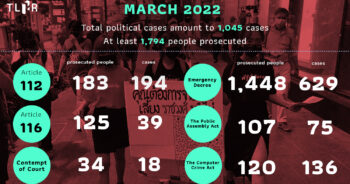
Human Rights Situation Report March 2022
In March 2022, intensification of the political situation in Thailand still remains. Additionally, at least 10 individuals were accused of violating Article 112. Meanwhile, other accusations were gradually prosecuted in courts and witnesses were summoned to testify, as well as some cases had a verdict read. the Court acquitted four cases of the alleged violations […]
admin010
18/04/2565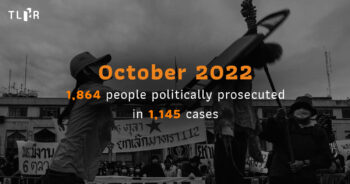
October 2022: at least 1,864 people were politically prosecuted in 1,145 cases
During the month of October, there were not many new individuals being prosecuted. However, the cases charged under Section 112 (Lèse-majesté) of Thailand’s Criminal Code and cases on the ground of violating the Emergency Decree for holding public assemblies during 2020 are still ongoing in court proceedings, including hearing verdicts. Even though the Emergency Decree […]

admin62
09/11/2565
[Analysis] Seven years after the coup: Lawsuits under the NCPO regime as “lawfare” (part 2)
The coup d’état on 22 May 2014 has left greater long-lasting legacies and enduring challenges for the resumption of democratic rule in Thailand than any previous coup over the past few decades. After the junta that launched the coup, the National Council for Peace and Order (NCPO) ruled the country for five years, one month, […]