
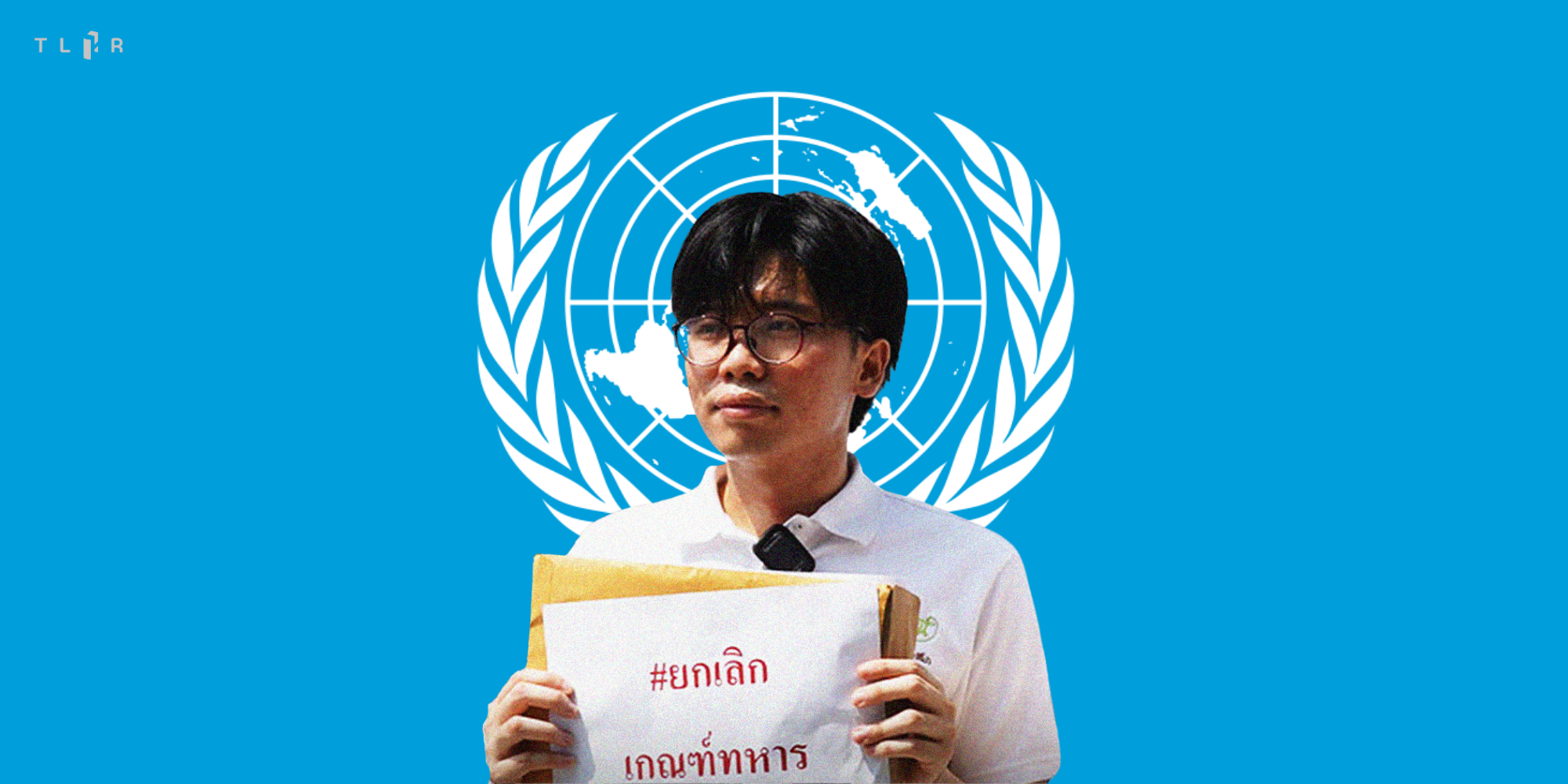
On 9 October 2025, Thai Lawyers for Human Rights (TLHR) submitted a communication to the United Nations (UN) experts regarding the issue of conscious objection in the case of Netiwit Chotiphatphaisal, a prominent Thai human rights activist and conscientious objector. The communication was submitted to:
(1) the Special Rapporteur on Freedom of Religion or Belief; and
(2) the Special Rapporteur on the Independence of Judges and Lawyers.
Case Background
On 5 April 2024, Netiwit publicly declared his refusal to participate in Thailand’s compulsory military conscription at the Bang Pu Municipality conscription center, following a long-standing history of conscientious objection.
On 8 November 2024, the Bang Pu police charged him with “evading or resisting military service” under Section 45 of the Military Service Act B.E. 2497 (1954). Netiwit pleaded not guilty to these charges. Trial proceedings were held on 10–11 September 2025 (Black Case No. Aor. 3168/2568).
On 11 September 2025, defense counsel filed a petition to the Constitutional Court, challenging the constitutionality of compulsory military conscription under Sections 26 and 31 of the 2017 Constitution.
The verdict hearing is scheduled for 19 January 2026 at the Samut Prakan Kwaeng Court.
Criminalization of Conscientious Objection in Thailand
As explored in our conscientious objection explainer, the right to conscientious objection is recognized under international human rights law as part of the freedom of thought, conscience, and religion, protecting individuals from being compelled to perform military service contrary to their deeply held beliefs. States that impose compulsory military conscription are therefore required to respect this right.
In contrast, Thailand’s Military Service Act B.E. 2497 (1954) requires all eligible Thai men to undergo compulsory military conscription, with refusal punishable by fines and imprisonment. This legal framework has been applied in the case of Netiwit Chotiphatphaisal, a prominent Thai human rights activist and conscientious objector. After more than a decade of publicly declaring his conscientious objection, Netiwit refused to participate in the 2024 draft lottery. As a result, he was indicted under Section 45 of the Act and faces up to three years’ imprisonment.
Netiwit’s objection is rooted in deeply held religious, ethical, and political beliefs. He maintains that compulsory conscription is undemocratic, violates human rights, and conflicts with core Buddhist principles of non-violence. Despite this, Thailand does not recognize the right to conscientious objection and provides no alternative civilian service, placing it in violation of established international human rights standards.
Thailand’s Violation of Freedom of Thought, Conscience, and Belief and the Right to a Fair Trial
In its submission to the UN experts, TLHR highlights Thailand’s ongoing violations of the right to freedom of thought, conscience, and belief, as well as the right to a fair trial, in connection with the criminal case brought against Mr. Netiwit.
1. Violation of the right to freedom of thought, conscience, and religion (ICCPR Article 18(1))
Article 18 (1) of the ICCPR states that:
“Everyone shall have the right to freedom of thought, conscience and religion. This right shall include freedom to have or to adopt a religion or belief of his choice, and freedom, either individually or in community with others and in public or private, to manifest his religion or belief in worship, observance, practice and teaching.”
Netiwit’s lifelong adherence to Buddhist precepts of non-violence and his ethical opposition to military power form the basis of his objection. Article 18 of the ICCPR protects the right to refuse military service when it conflicts with one’s beliefs, a right the UN Human Rights Committee has repeatedly affirmed. Thailand’s failure to recognize conscientious objection and provide alternative service is incompatible with these standards. By prosecuting Netiwit for refusing military conscription and subjecting him to the risk of imprisonment, the Thai authorities have imposed coercive measures that compel him to act against his conscience. Thailand’s failure to recognize conscientious objection or to provide an alternative civilian service therefore constitutes an unjustifiable interference with the rights protected under Article 18(1).
2. Violation of the right to adequate facilities to prepare a defense (ICCPR Article 14(3)(b))
Article 14(3)(b) of the ICCPR states that
“In the determination of any criminal charge against him, everyone shall be entitled to the following minimum guarantees, in full equality:
(b) To have adequate time and facilities for the preparation of his defence and to communicate with counsel of his own choosing;”
To put this another way, the defense has the right to be granted access to documents or other evidence that are both incriminating and exculpatory.
Alongside asserting Netiwit’s right to conscientious objection, the defense also challenged Thailand’s mandatory conscription law as unnecessary and disproportionate, noting that the military drafts an exceptionally large share of eligible men each year. To support this argument, defense counsel requested statistical and policy documents from the Ministry of Defense explaining how the scale of conscription is justified. The Ministry refused to provide this information, and the Court declined to issue subpoenas. As a result, the defense was unable to meaningfully challenge the law under which Netiwit was prosecuted, undermining his right to adequate facilities to prepare a full defense under Article 14(3)(b) of the ICCPR.
3. Violation of the right to an independent tribunal (ICCPR Article 14(1))
Under Article 14(1) of the ICCPR, judicial independence requires that courts decide cases free from any external or internal influence, pressure, or interference. This includes independence not only from actors outside the judiciary, but also from fellow judges and court officials who hold administrative authority.
During the trial on 10–11 September 2025, the presiding judge stated that he would consult his administrative superior, the head of the Samut Prakan District Court, before ruling on the defense’s request for subpoenas to obtain crucial evidence from the Ministry of Defense. After the head of the Court disagreed with the defense’s request, the presiding judge denied the subpoenas. This involvement of a non-presiding judge in a procedural decision undermined judicial independence and Netiwit’s right to have his case decided free from undue influence.
TLHR calls on the UN Special Rapporteurs to urge the Thai government and judiciary to:
- Acquit Mr. Netiwit Chotiphatphaisal of all charges related to his refusal of military service, which constitutes the protected exercise of his right to freedom of thought, conscience, and belief.
- Recognize the right to conscientious objection in Thai law and amend the Military Service Act to bring it into full compliance with international human rights standards.
- Establish an alternative civilian service system that is accessible, non-punitive, and consistent with global best practices for individuals who cannot undertake military service on grounds of conscience.
ข่าวหรือบทความที่เกี่ยวข้อง
TLHR report four years on from coup: Thai society “wrecked” by NCPO
22 June 2018 — Thai society has been “wrecked” by the National Council for Peace and Order, Thai Lawyers for Human Rights (TLHR) has said in its newly released report on four years of military rule in Thailand. The report, which was launched on Friday at the Foreign Correspondents’ Club of Thailand, warns of the […]

TLHR
22/06/2561
Having car set on fire two times, being beaten up six times, the steep price paid by Ekachai Hongkangwan
Ekachai Hongkangwan is a freelance writer and political activist. His activism has become prominent in the aftermath of the 2014 coup, around 2016. He has been campaigning on different issues: demanding an investigation on the failure to report assets (including 25 luxurious wristwatches) by Gen Prawit Wongsuwan, aka ‘The Rolex General’: searching for a plaque […]
TLHR
03/04/2562
The rise of systematic violence: observations on the attacks against political activists
On the evening of 2 June 2019, Sirawith Seritiwat aka “Ja New” was attacked by five or six men at the bus stop on Ratchadapisek 7 in Bangkok. The ambush took place just three days before the Parliament was set to vote to elect Thailand’s 30th Prime Minister and the day Ja New announced he […]
TLHR
12/06/2562
Thailand’s 12 most egregious human rights violations in 2019, in absentia of NCPO
2019 marks a year of change, but not transcendence in Thailand. The National Council for Peace (NCPO) is now defunct, after more than five years and one month since the military coup. The general election was followed by the return of the same old Prime Minister, the same face and the same name, plus the […]