
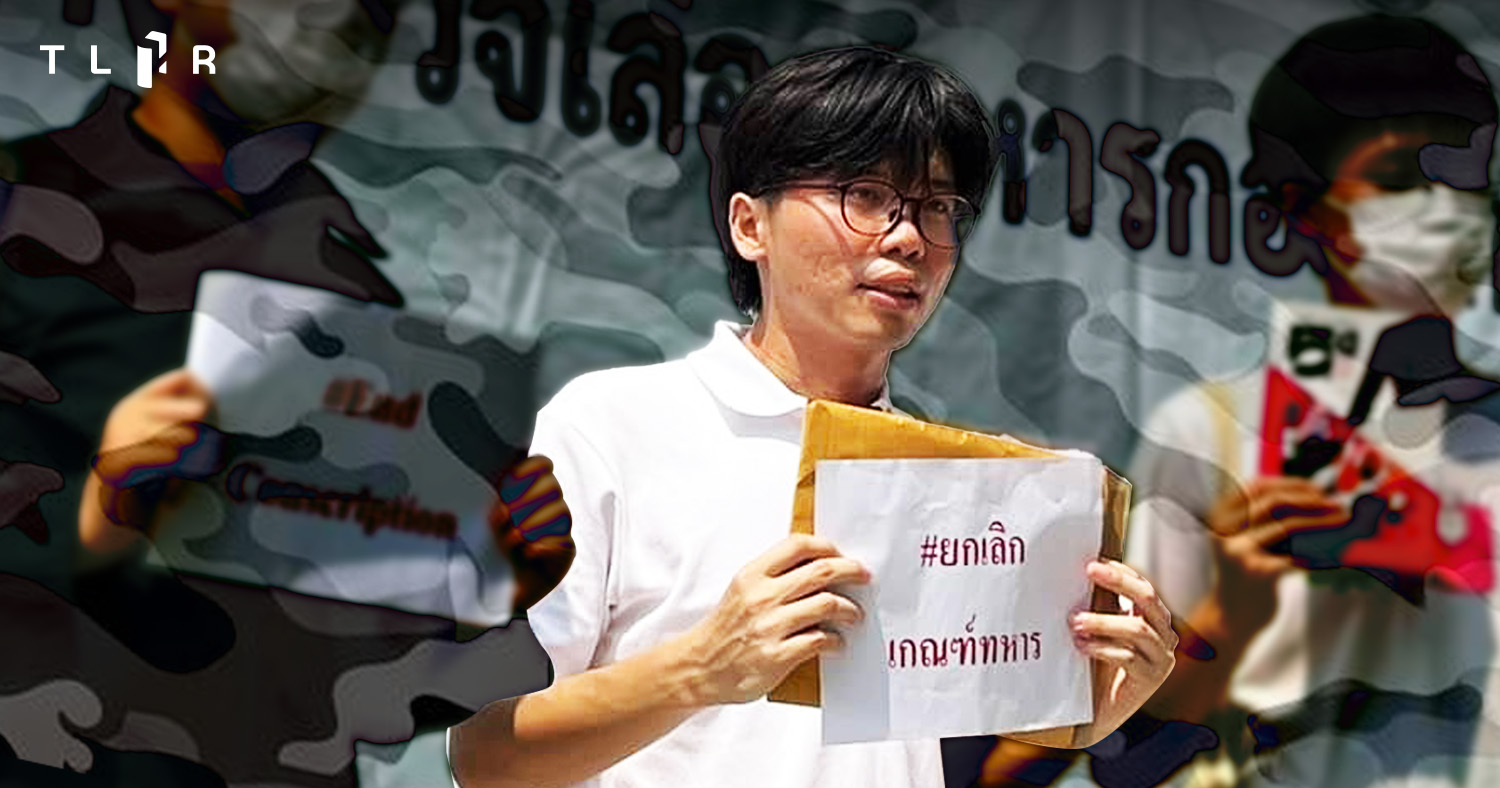
“No citizen should be forced to engage with a system that promotes violence or goes against their moral or ethical beliefs…Thailand’s conscription system has enabled corruption, abuse, and unchecked military power for far too long,” said Thai student activist Netiwit Chotiphatphaisal, not only rejecting the draft but also declaring that no government should compel a person to betray their conscience.
On 5 April 2024, Netiwit Chotiphatphaisal publicly refused to participate in the compulsory military draft at the Bang Pu conscription center, declaring his conscientious objection, and was later charged under Section 45 of the Military Service Act. His case turned what might appear to be a private decision into a public test of principle, raising questions at the core of human rights.
The right to conscientious objection lies at the heart of this debate. At its core, conscientious objection is the refusal to perform compulsory military service because of conscience, belief, or religion. Yet the issue extends beyond the battlefield and speaks to the limits of state authority and the right of individuals to resist when obedience would violate deeply held convictions. Netiwit’s case highlights the line between state power and the protection of personal conscience.
For many objectors of military service, this refusal is rooted in a conviction that killing or participating in violence is fundamentally wrong. It might be a religious belief that forbids killing, a moral principle against violence, or a personal code that values peace above obedience. The right underscores a core principle: states may require service, but they cannot compel conscience.
The aim of this article is to investigate how that line is drawn under international human rights law. It explores the jurisprudence of the UN Human Rights Committee and the manner in which it has applied the International Covenant on Civil and Political Rights (ICCPR)—to which Thailand has long acceded—in the context of conscientious objection to mandatory military conscription. It then compared Thailand’s mandatory conscription law against international standards.
.
The Right to Conscientious Objection under International Human Rights Law
UN Human Rights Committee Jurisprudence on Conscientious Objection
The recognition of the right to conscientious objection under international law has evolved significantly over time, shifting from outright denial to its affirmation as an inherent component of the right to freedom of thought, conscience, and religion.
This right is grounded in Article 18 of ICCPR. Specifically, Article 18(1) guarantees everyone the right to freedom of thought, conscience, and religion, including the freedom to manifest religion or belief in worship, observance, practice, and teaching. At the same time, Article 18(3) allows restrictions only on the manifestation of religion or belief, and only if such limitations are prescribed by law and are necessary to protect public safety, order, health, morals, or the fundamental rights or freedoms of others.
In its 1984 decision, the UN Human Rights Committee denied the right to conscientious objection in L.T.K. v. Finland (1984), in a case concerning a Finnish man who was sentenced to nine months’ imprisonment for refusing to perform compulsory mfilitary service on ethical grounds. The Human Rights Committee dismissed the communication as inadmissible, stating that it raised no issue under the ICCPR, since, in its view at the time, the Covenant “does not provide for the right to conscientious objection; neither article 18 or article 19 of the Covenant … can be construed as implying that right.” (Para. 5.2).
However, the interpretation of Article 18 started to shift in the 1990s. In J.P. v. Canada (1991), a Quaker who refused to pay the portion of her taxes earmarked for military expenditures, instead depositing them with the Peace Tax Fund of Conscience Canada, Inc., an NGO, argued that Canada’s tax law violated her right to freedom of conscience and religion. Although the Human Rights Committee found the claim inadmissible as “refusal to pay taxes on grounds of conscientious objection clearly falls outside the scope of” Article 18, the Committee did recognize “the right to hold, express and disseminate opinions and convictions, including conscientious objection to military activities and expenditures.” (emphasis added) (Para. 4.2).
Soon after, in 1993, the Human Rights Committee clarified its position in General Comment No. 22, explicitly recognizing that the right to conscientious objection “can be derived from article 18, inasmuch as the obligation to use lethal force may seriously conflict with the freedom of conscience and the right to manifest one’s religion or belief.” This recognition was further reinforced at the political level when the UN Commission on Human Rights (predecessor of the UN Human Rights Council) adopted Resolution 1998/77, affirming the right to conscientious objection to military service as a legitimate exercise of the right to freedom of thought, conscience, and religion under Article 18 of ICCPR.
The Human Rights Committee’s landmark decision in Yoon and Choi v. Republic of Korea (2006) marked a major step forward in recognizing the right to conscientious objection. The two complainants, both Jehovah’s Witnesses, were imprisoned for refusing compulsory military service on the basis of their religious beliefs. Departing from its earlier position in L.T.K. v. Finland (1984), the Committee affirmed that Article 18 of the ICCPR encompasses the right to conscientious objection, noting that “the understanding of [Article 18] evolves as that of any other guarantee of the Covenant over time in view of its text and purpose.” (Para. 8.2).
The Committee observed that “the authors’ refusal to be drafted for compulsory service was a direct expression of their religious beliefs, the authenticity of which was not disputed by the State. The authors’ conviction and sentence, accordingly, amounts to a restriction on their ability to manifest their religion or belief.” (Para. 8.3).
Notably, this case analyzed conscientious objection through the framework of Article 18(3), which permits restrictions only if prescribed by law and necessary to protect public safety, order, health, morals, or the fundamental rights and freedoms of others. The Committee found that the Republic of Korea’s mandatory military conscription failed to meet these strict criteria. (Para. 8.4).
Addressing state arguments about national security and social cohesion, the Committee emphasized that “respect on the part of the State for conscientious beliefs and manifestations thereof is itself an important factor in ensuring cohesive and stable pluralism in society.” The decision made clear that national security cannot justify overriding fundamental freedoms: even in a country still at war, like the Republic of Korea, true social cohesion depends not on enforced uniformity but on the State’s respect for individual conscience and belief.
It further noted that “it is in principle possible, and in practice common, to conceive alternatives to compulsory military service that do not erode the basis of the principle of universal conscription but render equivalent social good and make equivalent demands on the individual, eliminating unfair disparities between those engaged in compulsory military service and those in alternative service.” (Para. 8.4). By affirming that the interpretation of Article 18 must evolve in light of contemporary understandings of human rights, the Committee’s decision in Yoon and Choi transformed the global recognition of conscientious objection from a matter of national discretion into a universal human right.
This line of reasoning was further advanced to protect individuals rights to conscientious objection in the Committee’s jurisprudence in Min-Kyu Jeong et al. v. Republic of Korea (2011), a case involving 100 complainants, all Jehovah’s Witnesses, who were imprisoned for refusing compulsory military service on the basis of their religious beliefs. Building on its landmark Yoon and Choi decision, the Human Rights Committee went further, affirming that the right to conscientious objection “inheres in the right to freedom of thought, conscience and religion” under Article 18(1) of the ICCPR.
By locating the right in Article 18(1) rather than treating it as a manifestation of belief subject to restrictions under Article 18(3), the Committee shifted the framework: states can no longer justify limitations by appealing to necessity or proportionality. Instead, conscientious objection is protected as a core, individual right that must be respected even in times of war. This development expanded the understanding that freedom of conscience extends beyond mere belief to concrete actions, such as the refusal to serve in the military.
The Committee further consolidated this point in Atasoy and Sarkut v. Türkiye (2012), a case where two Jehovah’s Witnesses were repeatedly prosecuted and fined for refusing compulsory military service on religious grounds. The Committee found that such punishment violated their freedom of conscience under Article 18(1) of the ICCPR, reaffirming that “the right to conscientious objection to military service inheres in the right to freedom of thought, conscience and religion” and must not be impaired by coercion. In rejecting the State’s reliance on Article 18(3) to justify limitations, individual opinion of Committee member Sir Nigel Rodley, jointly with members Mr. Krister Thelin and Mr. Cornelis Flinterman reasoned that “relying on 18(3) to curtail the right to conscientious objection to military service implies that circumstances could be envisaged in which the community interests contemplated by the provision could override the individual’s conscientious objection to military service.” Furthermore, the opinion underscored that “it is precisely in times of armed conflict, when the community interests in question are most likely to be under greatest threat, that the right to conscientious objection is most in need of protection, most likely to be invoked and most likely to fail to be respected in practice.” By grounding its analysis squarely in Article 18(1), the Committee rejected the notion that national security or public order could justify restrictions on conscience, while the individual opinion of Sir Nigel Rodley and his colleagues further stressed that this right is absolute in nature and non-derogable even in wartime.
Thailand’s Human Rights Obligation
Thailand’s system of compulsory military conscription raises serious concerns regarding its compatibility with Article 18 of the International Covenant on Civil and Political Rights (ICCPR). The Military Service Act B.E. 2497 (1954) requires all Thai men to undergo conscription at age 21, with refusal punishable by up to three years’ imprisonment under Section 25. The criminalization of conscientious objection places Thailand in direct breach of Article 18(1) of the ICCPR, as consistently affirmed by the UN Human Rights Committee in Yoon and Choi v. Republic of Korea (2006), Min-Kyu Jeong et al. v. Republic of Korea (2011), and Atasoy and Sarkut v. Türkiye (2012).
Thailand’s international obligations in this regard are underscored by its role as a current member of the UN Human Rights Council and by its voluntary pledges made upon election in October 2023, in which it committed to upholding the highest standards in the promotion and protection of human rights, cooperating fully with UN human rights mechanisms, and ensuring the implementation of its international human rights obligations, including those under the ICCPR.
Thailand therefore has not only a legal duty but also a self-declared moral responsibility to align its domestic laws, including the Military Service Act, with international human rights standards. Upholding the right to conscientious objection would demonstrate Thailand’s good faith in honoring its pledges and strengthen its credibility as a member of the Human Rights Council.
.
Protecting the Right to Say No
Conscientious objection is a litmus test of freedom of conscience and belief. Its recognition underscores the principle that individuals must not be forced to act against their deepest convictions, even when invoked in the name of national security. The protection of this right affirms the value of dissent, pluralism, and individual autonomy in democratic societies.
While international law now firmly recognizes conscientious objection as part of Article 18 of the ICCPR, gaps remain in practice. Prosecutions, such as the ongoing case against Thai activist Netiwit Chotiphatphaisal, demonstrate the divide between international legal principle and state practice. To comply with its international obligations, Thailand should immediately drop all charges against Netiwit Chotiphatphaisal and other individuals prosecuted for exercising conscientious objection, and amend the Military Service Act to recognize this right explicitly consistent with Article 18(1) of the ICCPR and the Human Rights Committee’s jurisprudence.
For the public, civil society, and policymakers alike, conscientious objection raises fundamental questions about the limits of compulsory service, the role of individual conscience, and the responsibilities of states to uphold human rights. It is not only a legal right but also a vital safeguard for human dignity in times of both peace and conflict.
.
ข่าวหรือบทความที่เกี่ยวข้อง
A roundup on 28 April: Eight alleged admins of Facebook pages raided and held in custody at the CSD, Criminal Court to deliver an order on the habeas corpus case at 10.00am on 29 April
There were two developments on 28 April 2016. First, relatives of the persons held in custody have gone to the Bangkok Criminal Court to file a complaint asking the Court to review the lawfulness of the detention and to have them released from custody. The Court will deliver the verdict on 29 April at 10.00am. […]

TLHR
29/04/2559
Joint Statement: Asserting the right to freedom of assembly “We Walk…Solidarity Walk”
20 January 2018 The People GO Network is to launch the “We Walk…Solidarity Walk” from 20 January – 17 February 2018 to raise public awareness about issues concerning natural resources, alternative agriculture, health assurance, and the exercise of rights and freedoms. We plan to walk from Bangkok to Khon Kaen. And since 17 January […]

admin99
20/01/2561
Changes in Thailand’s lèse majesté prosecutions in 2018
Since late 2016, in the aftermath of the passing of King Rama IX and the accession of King Rama X, prosecutions of lèse majesté cases or the violation of the Penal Code’s Section 112 spiked sharply. The “witch hunt” or vigilante actions taken against people who hold different views led to prosecution of dozens of […]
TLHR
15/01/2562
Election under the shadow of NCPO: Updates on harassment against politicians
It is only a few days until the long awaited election. In the final weeks leading up to the vote, however, many incidents that make this election controversial have continued, particularly the response from the army toward politicians and the decision of the Constitutional Court to disband the Thai Raksa Chart Party. The Thai Lawyers […]