
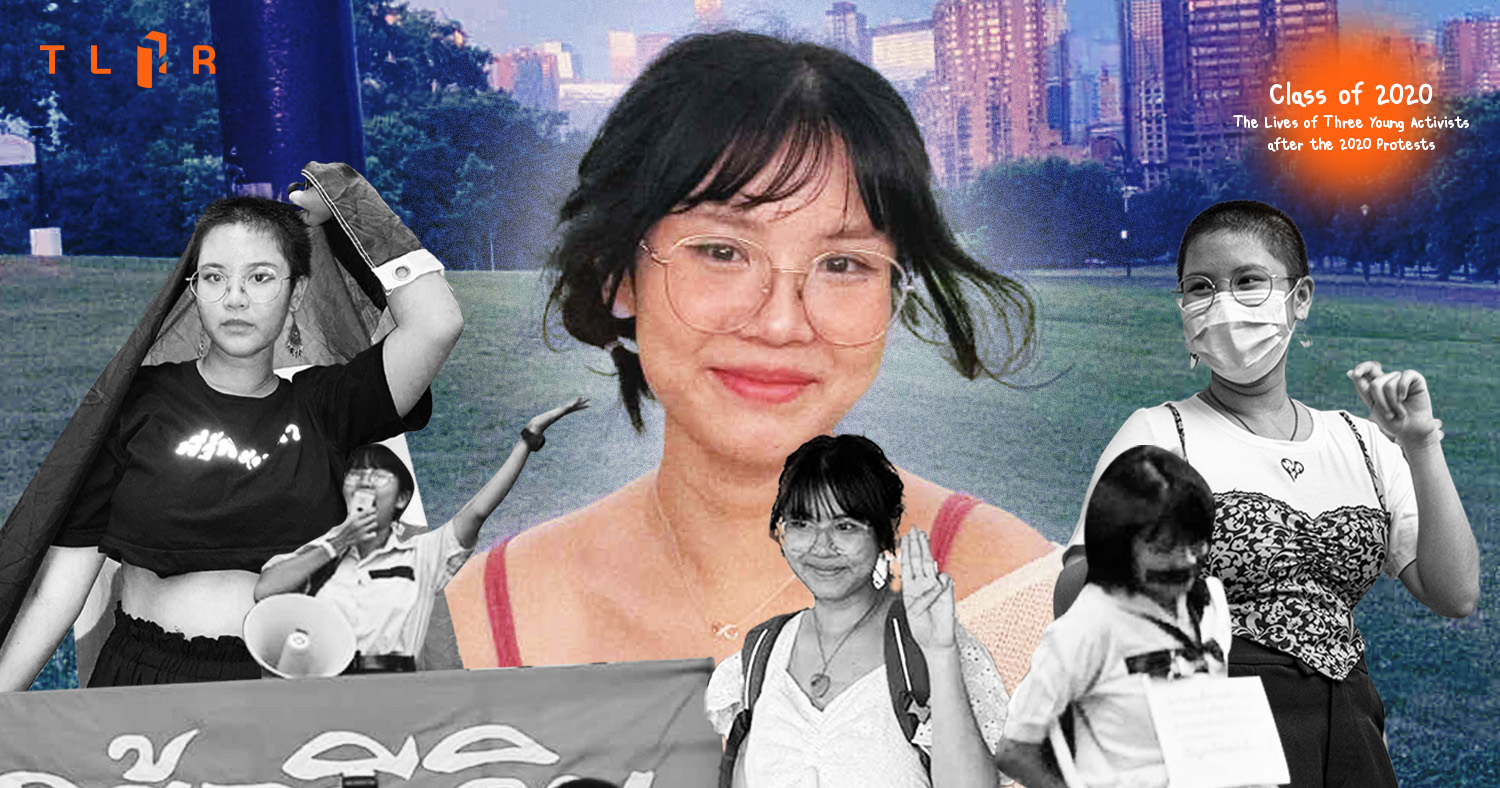
Class of 2020 EP.1 The Lives of Three Young Activists after the 2020 Protests
Interviewed/written by Veerapong Soontornchattrawat
.
There were no cakes or family wishes on her 18th birthday, only a can of cider—the first alcoholic beverage she could legally purchase. That was the night a young woman decided to leave her home in Bangkok and hid in a hostel in a neighboring country, keeping the pain inflicted by political activism in her memory. Now, she stands behind the bar of a bubble tea cafe in Vancouver, telling herself that life is a time crystal of pride, and hope is not yet extinguished.
Note: This series of interviews, ‘Class of 2020,’ was written by the author based on the interviews with three Thai youths who were politically active in 2020. It is presented in the form of a first-person monologue, allowing readers to hear their musings about their lives and contemporary Thai society.
——————————————–
.
Before I turned 15 and before Thanathorn Juangroongruangkit founded the Future Forward Party, I was just an ordinary kid who loved to draw, watch anime, and write novels. Besides being bright and cheerful, that kid was also quite docile.
In one interview with the media, I once said that I was hurt from being an obedient child because I lived according to society’s expectations. I was hurt by having to be a good student in the education system because I had to follow everyone’s expectations—classmates, teachers, family—everyone but myself.
The Future Forward Party was a crucial driving force that sparked my interest in politics. The advent of the party made me realize that “the voices of children and youth matter.” I started reading political history, starting from the October 14 uprising [a popular Thai uprising in 1973] up to modern Thai politics.
The heated politics found on Twitter inspired me to enter this path. At the time, the political current was intense and compelling, which led a kid like me to keep up with politics from then on.
.
.
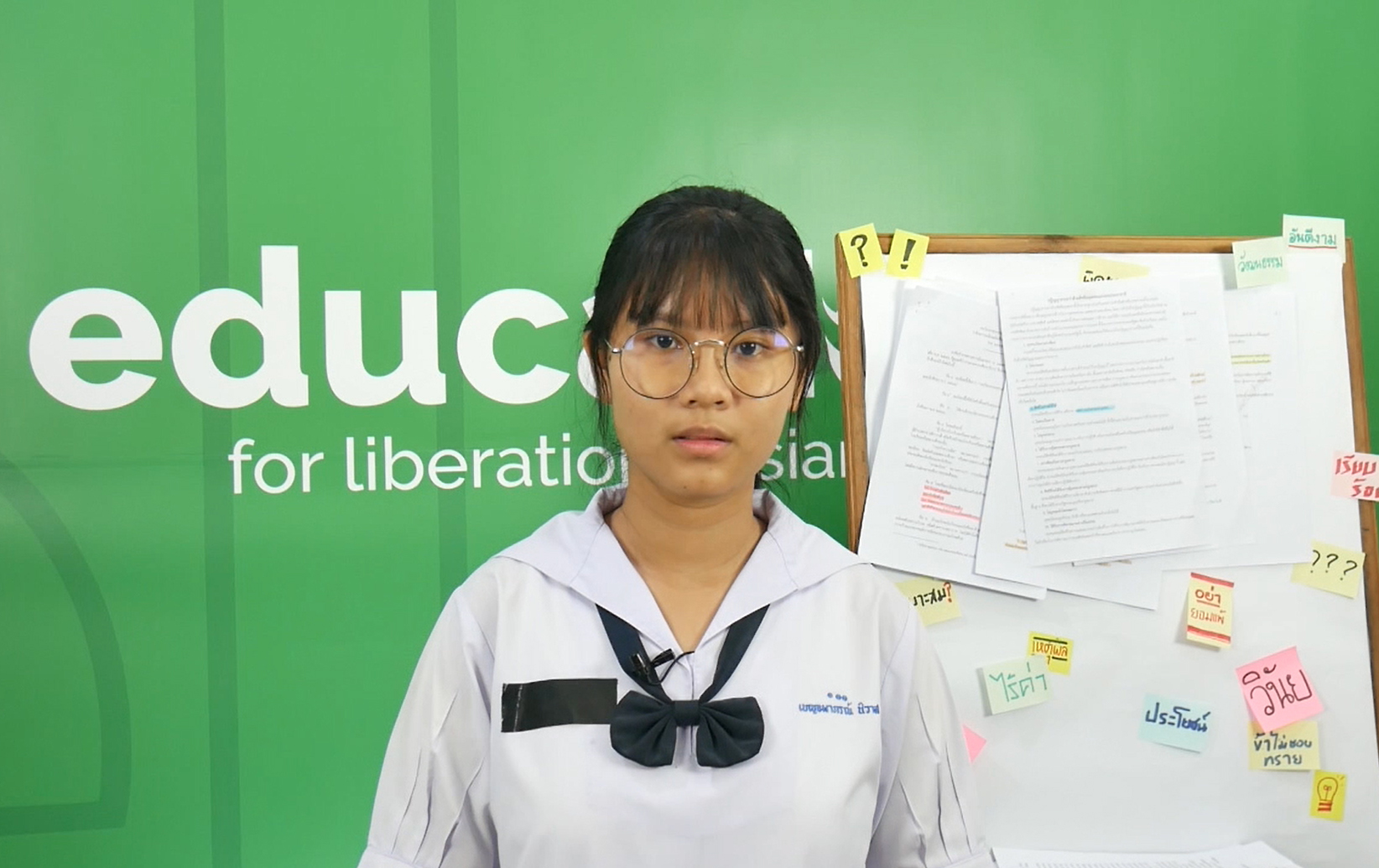
I was a student who never had the freedom to choose my own hairstyle, just like every student in this country. If my hair was too long according to regulations, the teachers would cut it. Some teachers even used clippers to shave my friends’ heads. I found this behavior unjust. The humiliation of being forced to bow down did not help anyone study better.
The Bad Students organization was a collective of high school students who suffered under the weight of the education system. We were frustrated by the oppressive authoritarianism in schools. We ran various campaigns in parallel with the 2020 protests.
I was 15 back then, but I was full of energy, courage, and confidence that I could change this country. We would change the rules on hairstyles. We would change the backward norms of society. We would change entrenched traditions that were inhumane.
In 2021, at the age of 16, I was charged with my first case—violating the Emergency Decree for being one of the student representatives who spoke at the ‘October 15 to Ratchaprasong’ protest. I never imagined I would ultimately become a refugee in the following year.
Similarly, back then, I couldn’t have known that the Court would rule to revoke the regulations concerning students’ hairstyles because the Court saw the 1972 Announcement of the Revolutionary Council as an undue restriction on an individual’s physical liberty, making the rule contradictory to the Constitution. My friends and I, representing the ‘Education for Liberation of Siam’ group, filed the suit for this case back in 2020. Who would have known that five years later, we would win?
In the case of “Pang Mak P’Nut”* (a social media meme meaning “Awesome, Nut”), the Bad Students group was brilliant to create such a change, allowing voices of the students to be heard. We did our best. I never regretted that period of time.
From the student hairstyle issue, the questions expanded to children’s rights, gender diversity, a welfare state, human rights, and even the monarchy. But the more we questioned, the more the charges came back, like crushing answers.
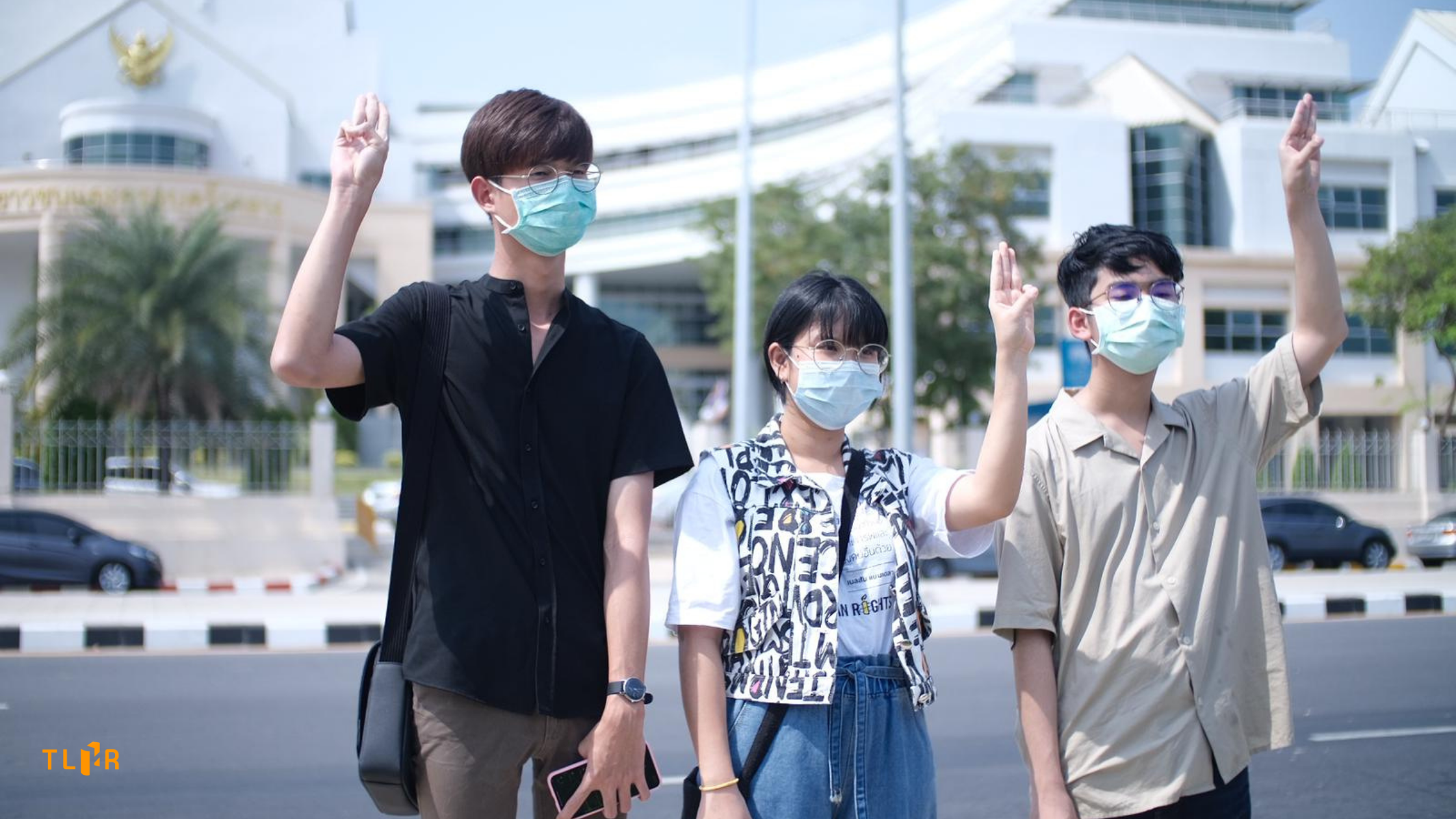
Back when I was an active member of the Bad Students group, my mother was pressured to leave her job. She had always been the main provider for the family. So, I felt a little self-blame—was it because of me that the family’s situation reached this point? I decided to leave home and stay with friends who were also activists. At least, I wouldn’t be a burden to my mother. After that, I joined the Thalu Wang group because I believed that we should be able to criticize the monarchy.
.
.
Between the ages of 17 and 18 was the period when my life broke apart—hopeless, isolated, and lacking a support pillar. I decided to drop out of school, had problems at home, and was harassed by state officials, which even extended to my family. I had no future, no one. Although the situation was difficult, I held on to the same ideology even on the day I had to cross the river by boat in order to flee.
I celebrated my 18th birthday despairingly in a neighboring country with a can of cider I legally bought myself. Perhaps adulthood began with the cider my friend and I drank in the hostel where we took refuge. That was the gift I gave myself at 18.
A month and a week later, my friend and I started a new life in Canada. A poor kid who didn’t know English and had never been on a plane had to adjust to the cold weather, strangers, and a new culture. Everything started from zero. Initially, I felt quite helpless—just sleeping, feeling depressed, and sinking into the bad memories of the past—but time gradually healed me. I entered adulthood, crossing over my wounds with new perspectives. I’m grateful for the pain from those moments that made me strong, resilient, and grown enough to stand proudly on my own.
I continue living with new memories, always accumulating good stories. Life is much more stable now. Canada is a country that values human rights and has a supportive welfare state, allowing me to live on a minimum wage and thrive in a country where I can see my future.
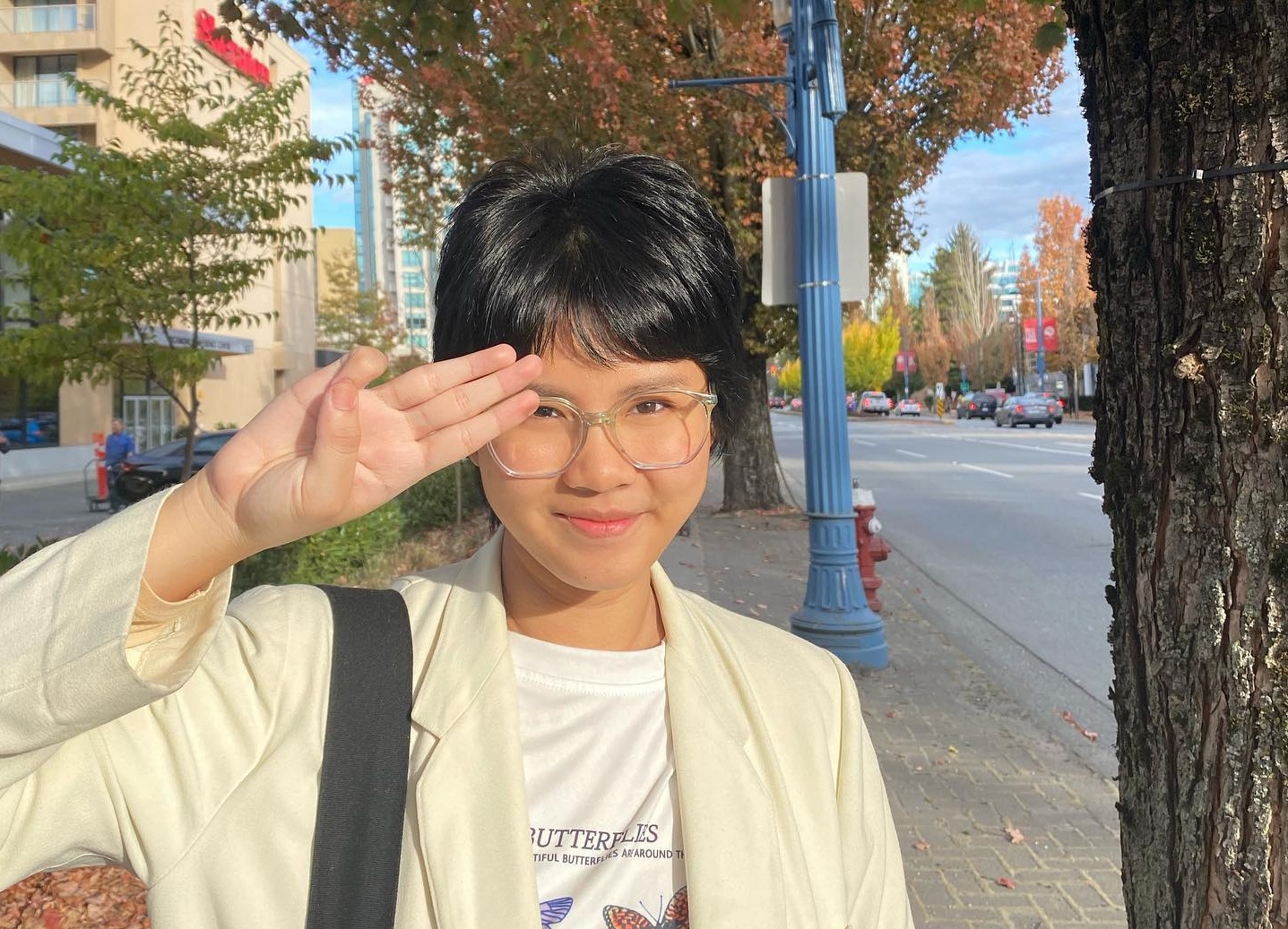
I now work as a barista in a bubble tea cafe while attending an online Adult High School. I’m currently in the equivalent of Mathayom 6 (12th grade), which should take another year, after which I can apply to university.
Vancouver is a city with a high cost of living. I have to learn many skills to survive in a country where I’m alone and in a rapidly changing capitalist world. Plus, I need to plan for my future and university studies.
This is a time in my life where I’m starting to look for new goals. I might move to study at a university in another city in Canada. I want to relocate and see new parts of the world.
Although there are lonely days, days when I’m homesick, miss Thai food, miss the low prices in Thailand, and miss my family, I try to live here as if it’s my second home. Thailand is my first home; Canada is the new home where I must live and make it work here as a Canadian. Because I can’t go back to Thailand, right? So, I have to adapt and get used to this new home.
.
.
I’ve grown up a lot in the past three years. From a child who was constantly looked down upon as a failure, an immature kid, and someone with no future, I’ve now proven to many that I can stand on my own, work at a job I love, meet genuine people, have dreams, have values, and live proudly every day.
If my life as a political refugee can be a lesson for the youth, I want the new generation to learn to never abandon hope. No matter how low life gets, I want to offer encouragement and pray for everyone to live with hope every day. Please, live with pride.
The time period between the ages of 17 and 18, when I faced nearly ten political charges and had to flee, was arguably the lowest point in my life. I had no future, no family, no education, not even a tomorrow to think of. But I still believed my life had a way forward, and I could make my own life better. So, I decided to leave, believing and hoping that I would see my own tomorrow, see the day I have rights and freedom, and see the day I truly live my own life with pride.
I still believe in the people’s hope and haven’t lost faith in the new generation because I believe everyone wants to see their life improve. There will be a day when the people raise their voices to change this country again, and no one will be able to stop our voices. Even though today’s activists are imprisoned, people are being summoned, or forced into exile. . .
we always have hope.
.
| Benjamaporn Nivas (Ploy) was an activist with the Bad Students group, advocating on the student hairstyle issue before becoming involved with the Thalu Wang group and deciding to seek political asylum in Canada. Ploy has been prosecuted in a total of 8 cases stemming from political protests and expression, all of which occurred when she was under 18 years old. Two of these are Section 112 (Lèse-majesté) cases regarding a poll conducted with the Thalu Wang group. If there is no amnesty for the Lèse-majesté charges, she still cannot return home. |
.
*“Pang Mak P’Nut” – An online meme used to express strong admiration or praise for something that someone has done well. It originated from a viral clip on Twitter.
.
ข่าวหรือบทความที่เกี่ยวข้อง
“Then and Now”: A Short Documentary about the Past and Present of Youth Prosecuted for Political Offenses
The short documentary film “Then and Now” explores the past and present of three youths who faced political charges for their involvement in protests and acts of expression in Thailand during 2020–2021. The film is a collaboration between the Thai Lawyers for Human Rights (TLHR) and independent writer and filmmaker Veerapong Soontornchattrawat. . . FacebookFacebookXXLINELine

admin010
07/10/2568
A statistical profile of minors charged for political expression and protest, 2020-2022
*Last updated on 16 September 2022 According to TLHR database on Juvenile prosecution (from 2020 onwards), at least 283 youths from 211 cases have been prosecuted for political expression and protest. After the phenomenon of continuous leaderless protest from 2nd August 2021 to the end of October 2021 at Din Daeng Triangle, the youth activist […]

TLHR
16/09/2565
Wanchalearm Satsaksit Remains Missing as UN Body Begins Review of Enforced Disappearances in Cambodia
April 4, 2022 – We, the undersigned organisations, remain deeply concerned about Cambodia’s failure to conduct a thorough, independent, transparent, and effective investigation into the suspected enforced disappearance of Thai activist Wanchalearm Satsaksit and the resulting impunity. As the UN Committee on Enforced Disappearances (CED) prepares for a preliminary review of the situation of enforced […]

admin62
04/04/2565
BRIEFING: CHILDREN’S EXERCISE OF THE FREEDOM OF EXPRESSION AND ASSEMBLY IN THAILAND
On 20 September 2022, Amnesty International Thailand together with Thai Lawyers for Human Rights (TLHR) organized a briefing on Children’s Exercise of the Freedom of Expression and Assembly in Thailand at The Eastin Grand Hotel Sathorn. The participants include representatives from TLHR, Amnesty International Thailand, Foreign Embassies, OHCHR, UNICEF, Department of Juvenile Observation and Protection, […]